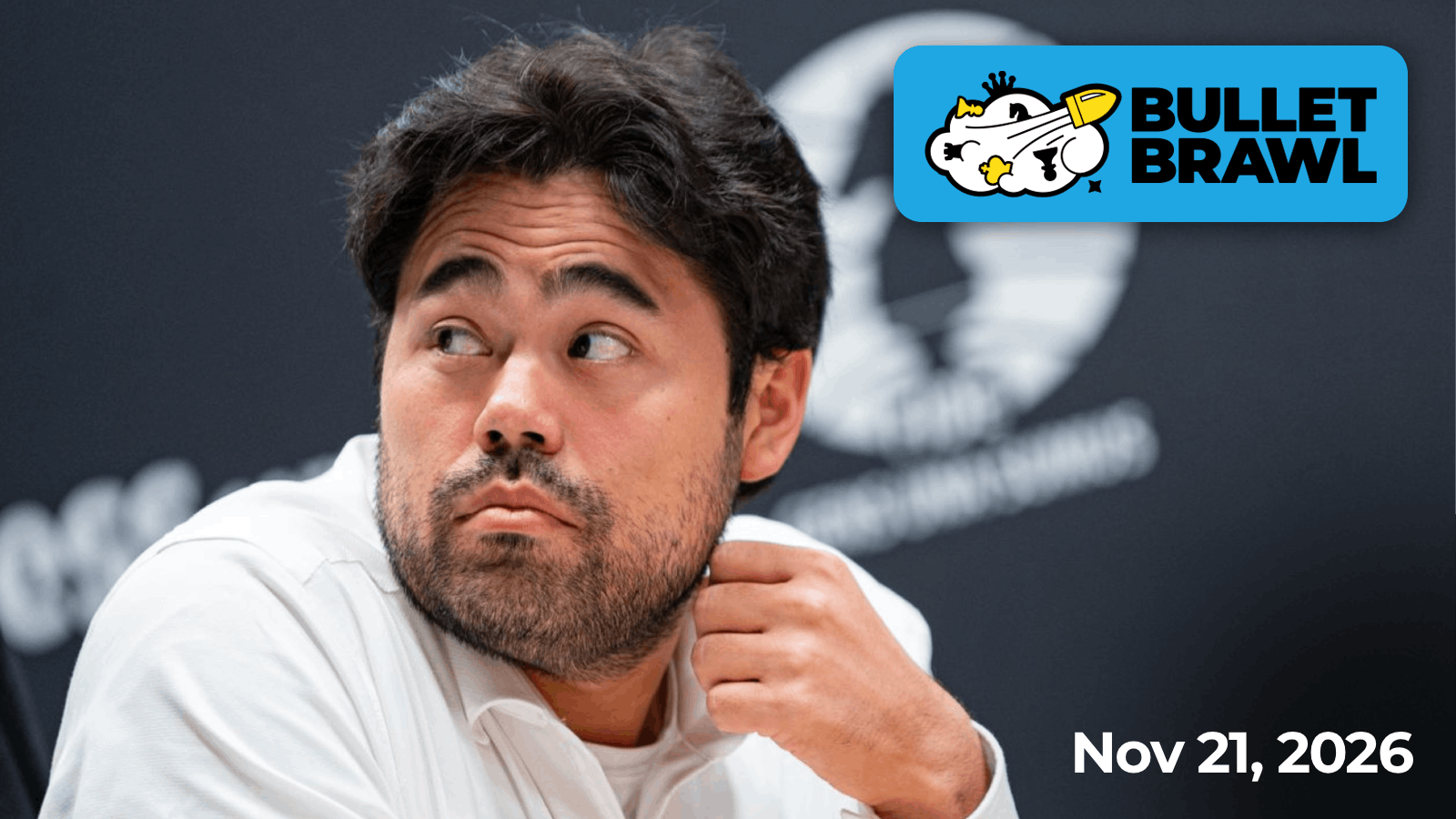
Hikaru Nakamura won his 75th Bullet Brawl title on Saturday, cementing his status as the format's undisputed master. He scored 183 points to claim the $400 first prize with convincing margin over the field.
This number matters because it reflects something deeper than tournament results. Nakamura has built a machine of consistency in bullet chess that separates him from every other player on Earth. Seventy-five titles is not a streak. It is a career-long obsession with a format that most super-GMs treat as a sideshow.
The gap between Nakamura's bullet output and his nearest competitors is enormous. No other player has collected anywhere near this volume of Bullet Brawl victories. This speaks to both his comfort with time scrambles and his technical preparation. At bullet speeds, intuition and calculation combine into something almost supernatural. Nakamura has weaponized that hybrid skill.
What makes this particularly telling is the company Nakamura keeps in these events. GM Arjun Erigaisi showed up as a major threat. Erigaisi represents the new generation of ultra-aggressive, computer-trained young talent. He prepares lines deeper than any player before him. He calculates faster. He thinks in engines. Yet in bullet, where preparation collapses and pure chess instinct takes over, Nakamura still found a way to outplay him.
This is Nakamura's true domain. Classical chess has belonged to others for years now. Magnus Carlsen held the rating crown for a decade. Ding Liren became world champion. Giri and Caruana and Vachier-Lagrave have all won classical tournaments at the highest levels. But bullet belongs to Nakamura. No one else has ever made the format a career focus the way he has.
The format itself has evolved. Bullet Brawl competitions have grown more serious over the past five years. The prize pools have swelled. The player pools have deepened. These are no longer pickup games between rounds of a classical tournament. They are standalone events where the world's elite sit down to slug it out for 90 seconds per side plus increment.
Nakamura's dominance in this environment reveals something about how modern chess divides. The classical game belongs to Carlsen, Ding, and the deep preparation crowd. Rapid belongs to players like Firouzja and Vachier-Lagrave who blend preparation with tactical sharpness. But bullet is pure chess. It is the format where you cannot hide behind a prepared novelty. You must simply play better than your opponent at speed.
Nakamura has chosen to master this. He has sunk hours into bullet that most players of his caliber would spend on classical openings. The result is 75 titles and a reputation that will outlast his rating gains in any single classical tournament. When chess historians look back, they will note that in the fastest chess, one man stood alone.
The win also matters for how Nakamura's legacy is building. He will likely never catch Carlsen's classical dominance. He will probably never wear the world champion title. But he owns bullet chess in a way no player owns any format. That is a legacy worth building.