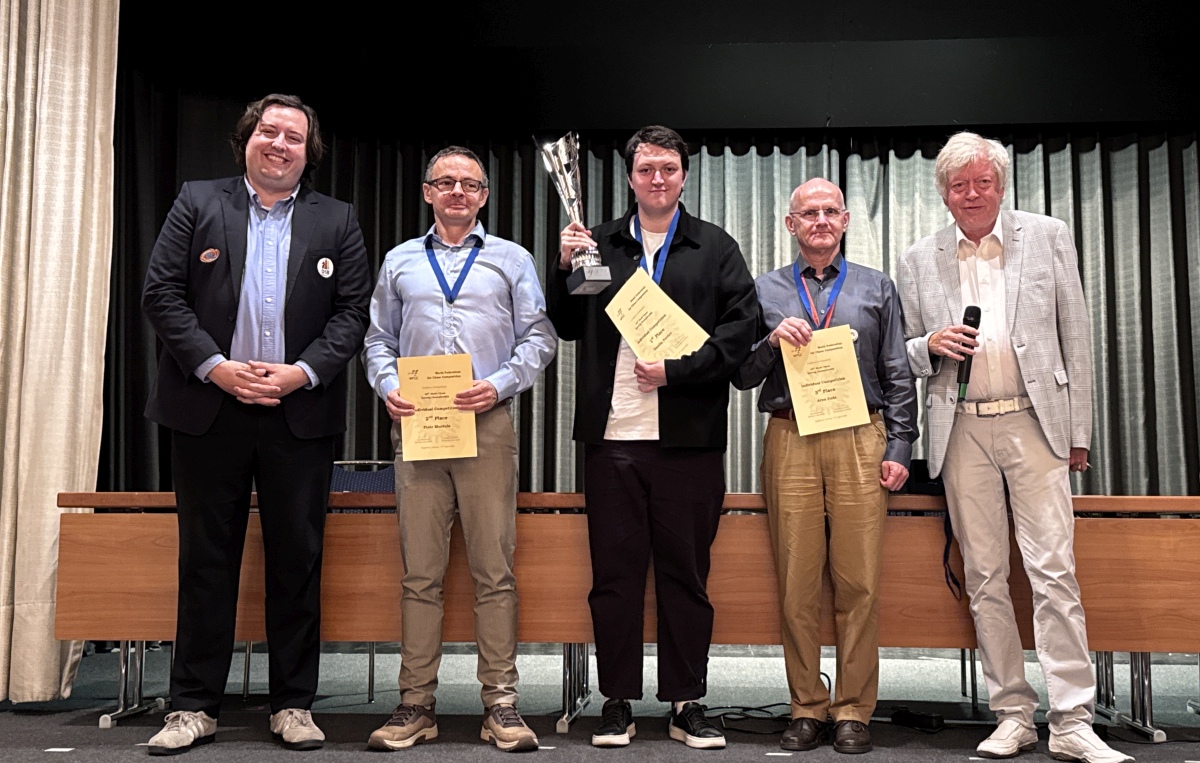
Danila Pavlov just ran the table. The Russian solver, competing under the FIDE flag, posted a perfect 90 out of 90 at the 49th World Chess Solving Championship in Magdeburg, solving all 18 problems flawlessly across six rounds. This marks his fourth world title in composition chess, placing him among the discipline's all-time greats.
What makes Pavlov's clean sheet remarkable is that solving competitions do not reward speed over accuracy. Every problem counts equally. A single slip, one misread position or calculation error, tanks the entire score. Pavlov did not slip.
The solving game operates in a different universe from over-the-board play. Solvers face composed positions, often with a stipulated task. "White to play and mate in three." "Find the only move that wins." These puzzles can contain depths that no tournament game would ever reach. The problems demand calculation, pattern recognition, and the ability to see multiple forcing variations simultaneously. It is chess at its most demanding.
Germany claimed the team title on home soil, ending Poland's run of dominance in the format. The German trio of Arno Zude, Ulrich Voigt, and Boris Tummes scored 169 combined points, matching Poland's total. Tiebreak rules favored the Germans. Lithuania finished third with 162.25 points, rounding out the podium.
Poland's loss of the team crown represents a genuine shift. They had controlled this competition for years. German chess has long produced strong solvers, but capturing gold at a world championship in Magdeburg signals renewed depth in the talent pipeline. Voigt and Zude are veteran names in solving circles, yet this team victory proves the federation maintains its competitive edge.
For Pavlov, the fourth world title puts him in elite company. Solvers rarely accumulate this many championships across their careers. The consistency required, round after round and year after year, exceeds what most players can sustain. His perfect score removes any argument about his place in the hierarchy.
Solving championships receive far less media attention than classical tournaments, yet they represent one of chess's purest tests. There are no clocks, no time pressure, no psychological gamesmanship. Only the position and the solver's ability to crack it. Pavlov cracked everything placed before him. That is dominance at its clearest.