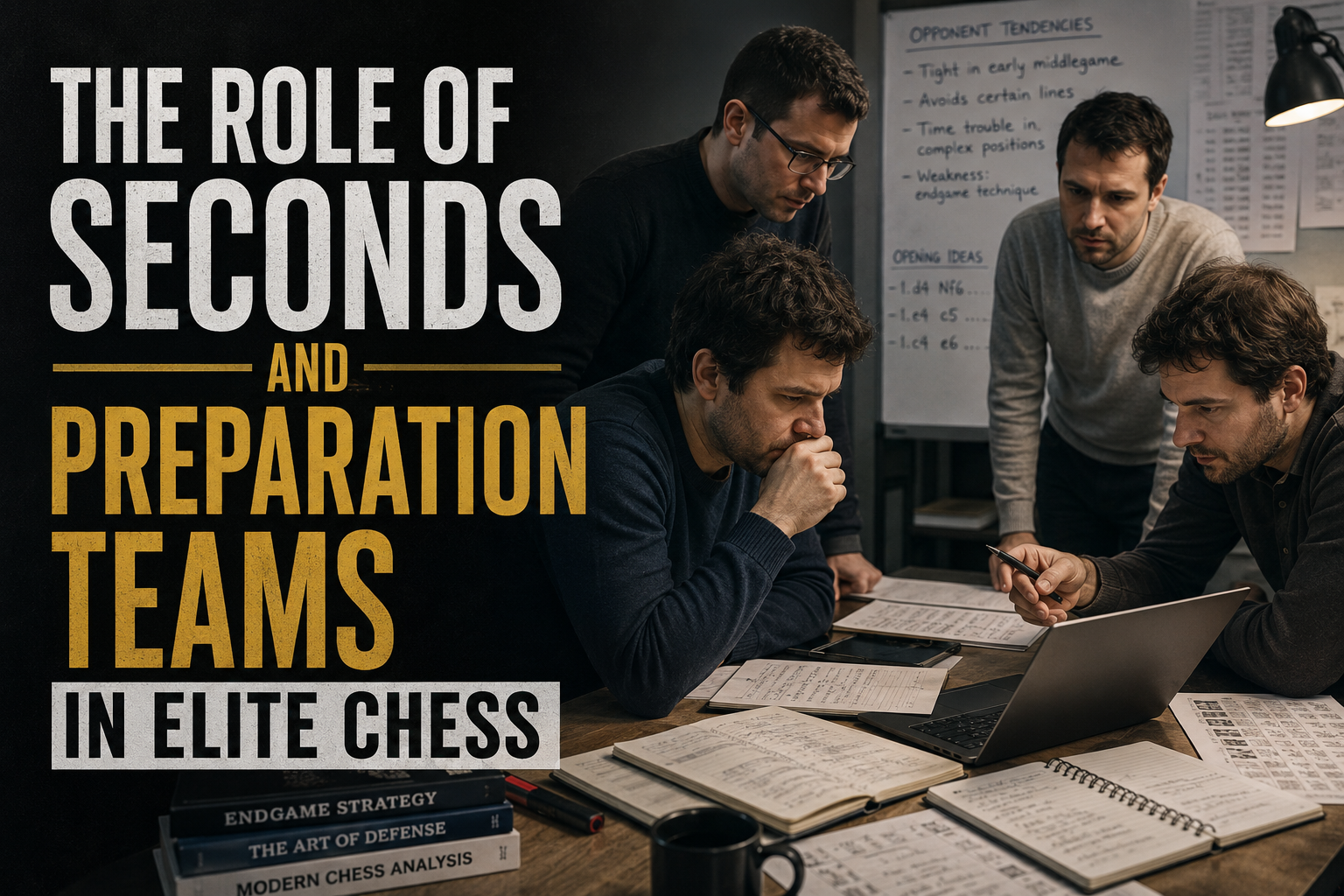
# The Invisible Match: Why Every World Champion Needs a War Room
Vishy Anand did not win the 2007 World Championship alone. Neither did Magnus Carlsen in 2013, nor Ding Liren in 2023. The chess world sees one player at the board. Behind the scenes sits an entire operation. Seconds, coaches, opening specialists, endgame theorists, and psychological advisors work in shifts, analyzing thousands of games, stress-testing preparation, and keeping the champion's mind sharp between rounds.
This is not a modern invention. Boris Spassky trained for his 1972 match against Bobby Fischer in the Trans-Elbrus region under Nikolai Krogius, a coach who understood that preparation was systematic warfare. By 1973, Spassky's team expanded further. They rented a training camp near Moscow and brought in guest grandmasters to study roughly 500 of Fischer's games. They were hunting for patterns, weaknesses, recurring mistakes. They built a map of Fischer's mind.
Fischer, notably, rejected this model entirely. He prepared alone. He was the exception that proved the rule. Even geniuses operate differently at the board when they face a peer of their caliber.
Modern preparation teams are exponentially more complex. A world championship challenger now requires specialists who do different jobs. The opening theorist knows the latest 20-move lines in the Najdorf and the Catalan. The endgame specialist drills technical positions that might arise in the final hours of a grueling game. The psychology consultant monitors fatigue, confidence, and mental resilience across ten rounds. Video analysts study opponent tendencies: does your rival push h-pawns in time pressure? Does he avoid certain rook endgames? A dedicated computer analyst manages engine preparation, ensuring the team does not waste time on lines computers have already solved.
The cost is substantial. Top teams spend hundreds of thousands of dollars. The benefit is measurable. Players who prepare with strong seconds draw more games against superior opponents. They find resources in positions they should lose. They avoid the catastrophic blunders that come from fatigue and isolation.
What changes is subtle but real. A champion with a weak team plays tighter, more defensive chess. He conserves energy instead of pressing advantages. A champion with a strong team plays with confidence. He knows his preparation is solid. He trusts his analysis. He can focus on calculation and intuition rather than second-guessing his theoretical understanding.
This is why the composition of a player's team matters as much as his rating. Carlsen's team. Giri's advisors. Gukesh's coaches. These names rarely appear in tournament reports. The prize money goes to the player at the board. The preparation happens in the rooms nobody watches. And that is precisely where many matches are actually decided.