# Iran Built for Olympiad Success. Everyone Else is Playing Catch-Up.
Iran arrives at the 2026 Olympiad with the clearest message of any West Asian federation: we are here to compete at the highest level. Their Open team construction is unambiguous. Three grandmasters. Two international masters. No filler. GM Tabatabaei M. Amin at 2726 anchors a squad that means business. The women's contingent backs this up with equal professionalism: a WGM and four WIMs, meaning Iran can field an entirely titled roster on both sides of the board.
This isn't theoretical dominance. This is structural superiority. Iran has built teams designed to score, not simply participate.
Nothing else in West Asia operates at this intensity. The gap between Iran and the next tier is stark enough that it reshapes the entire regional dynamic.
Kuwait presents the tournament's most interesting wrinkle. The federation registered no separate women's team, but they solved that problem by integrating WCM Alawadhi Amenah directly into their Open roster. She competes alongside her male teammates rather than in a dedicated women's section. This is unusual in modern Olympiad structure. Most federations preserve the traditional gender divisions. Kuwait chose integration instead. Whether this reflects progressive chess culture or pragmatic federation logistics depends on your read of the situation, but the result is the same: Alawadhi faces the same competition table as the men around her. Her rating and results will stack against male opposition without qualification or separation.
The structural choice says something about Kuwait's confidence in her abilities and their willingness to break convention. It also means the federation's overall competitive pool is smaller than Iran's. They cannot field both a full Open team and a parallel women's squad. Iran can. That matters for medal projections.
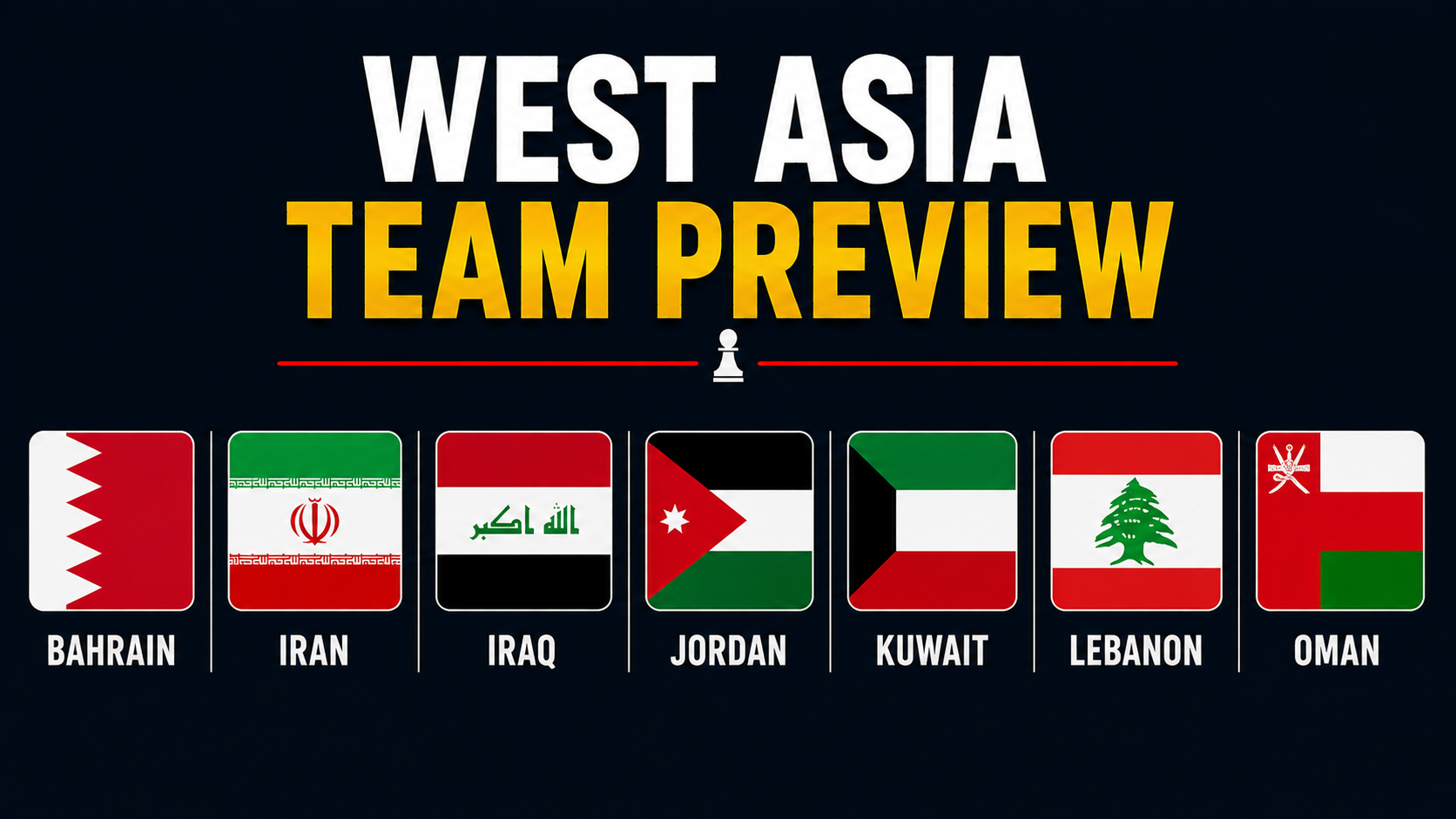
Bahrain and Iraq round out this preview. Jordan presumably completes the West Asian contingent, though the excerpt cuts off before details emerge. The pattern, though, is already visible: Iran enters as the region's clear favorite. They've invested in deep title depth. They've built backup plans. They've constructed redundancy into their squad composition.
The other federations are sending players. Iran sent a team built to win.
The Olympiad format punishes depth deficiency across boards one through five. You cannot patch weak spots with one strong player. Iran understood this. They loaded their lineup accordingly. For the West Asian region, this Olympiad belongs to Iran before a single game is played. The real competition will be for silver, and that race looks wide open between federations still figuring out their squad-building philosophy.