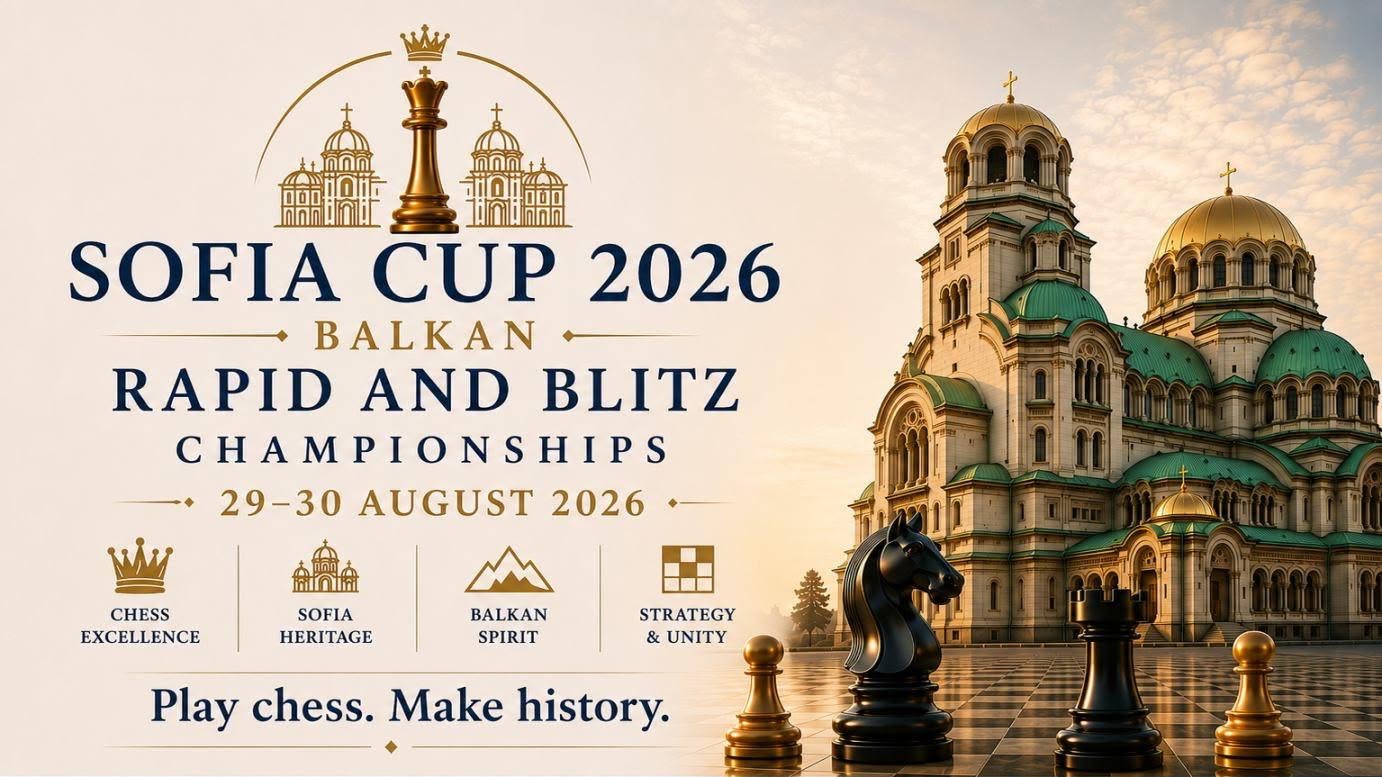
Sofia hosts the Balkan region's final warm-up tournament this weekend, and the timing matters. The Rapid and Blitz Championships arrive at the Grand Hotel Sofia just sixteen days before the Samarkand Chess Olympiad, giving the Balkans' elite one last chance to sharpen their form before the year's biggest team event.
The schedule packs two championships into two days. Friday brings the Rapid Championship with nine rounds at 10+5, split into morning and afternoon sessions. Saturday flips to Blitz with eleven rounds at 3+2, also broken into two sessions. This compressed format forces players to stay sharp across different time controls, something the Olympiad teams will need desperately.
The regional significance here is real. The Balkans have produced serious chess talent over the past decade. Romania's Firouzja (by birth), Serbia's Predojevic, Bulgaria's Ganguly, and Greece's Sargissian have all competed at elite levels. This tournament pulls together whoever represents the region's current strength, and the Olympiad team compositions will depend partly on these results. A player limping into Sofia with a 2300 rating after a poor summer might not make the final squad. A 2450 player who catches fire here becomes harder to leave off.
The rapid format rewards practical play over deep preparation. At 10+5, you cannot calculate thirty moves ahead. You need pattern recognition and the ability to make sound decisions under time pressure. This is precisely what Olympiad rapid games demand. Teams often face unexpected openings, weird position types, and psychologically challenging moments when the clock ticks down. Players who perform well here have answered the fundamental question: "Can I play chess when I'm thinking fast?"
Blitz amplifies that pressure. Three minutes plus two seconds is barely chess by classical standards. It becomes intuition and calculation speed. But blitz results at this level tell you something about a player's overall confidence and tactical sharpness. You cannot play decent blitz if your calculation engine is rusted.
The tournament also serves a secondary purpose: roster confirmation. Balkan federations finalize Olympiad teams in early September. Coaches watch these games to see who deserves selection, who's peaking, who's falling off. A strong weekend in Sofia can salvage a mediocre summer. A weak showing can cost a player a spot on the team.
Sofia's location makes this sensible. The city sits roughly midway between most Balkan federation capitals, minimizing travel. The Grand Hotel Sofia has hosted chess events before. Logistics matter less than the competitive atmosphere, and this format delivers exactly that. Two championship titles, two days, one region, one window before Samarkand.