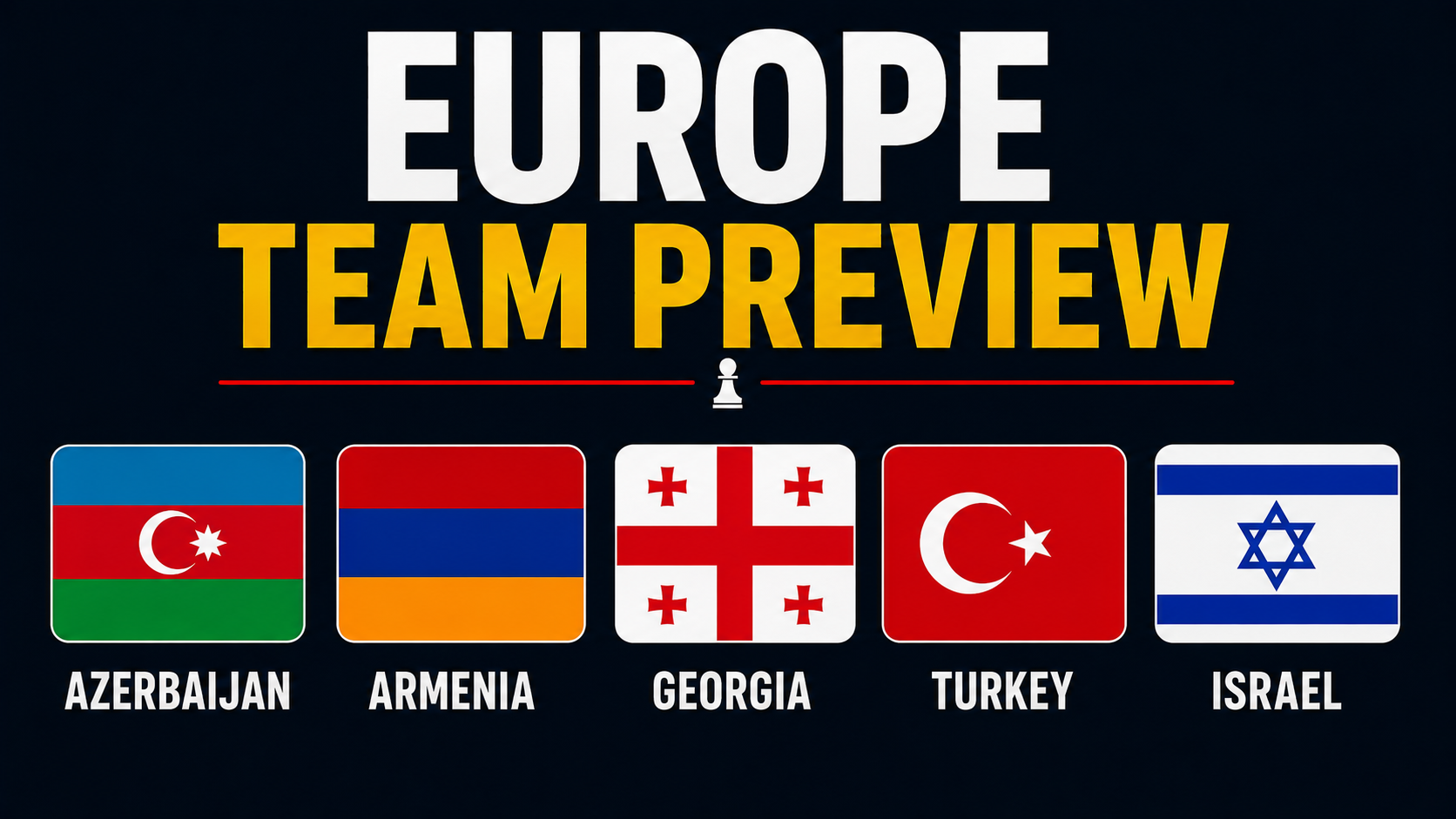
# Europe's Eastern Tier Has Quietly Become the Olympiad Powerhouse
Georgia, Armenia, Azerbaijan, Turkey, and Israel represent something chess has never seen before. Every one of these ECU-affiliated nations will field five grandmasters in their Open team at the 2026 Olympiad. Every single one. Not four. Not three mixed with an IM. Five GMs each.
This matters because it marks a threshold shift in how chess talent distributes globally. Africa hasn't managed it. The Americas haven't managed it. Asia hasn't managed it. Yet this cluster of five nations, stretched across the Caucasus, Anatolia, and the Levant, all cleared the bar simultaneously.
The density tells you something. These countries aren't maintaining one world-class player and padding the roster. They're running deep benches. Georgia demonstrates the point most visibly. The country seeds second in the entire Women's section. That's not a regional achievement. That's a global ranking.
Turkey built this over two decades. Giri, Caruana, and others passed through Turkish clubs during the post-2000s chess revival there. The federation invested. Now it pays dividends on the Olympiad stage.
Azerbaijan leveraged its oil economy into chess infrastructure starting in the Kasparov era and never stopped. Radjabov and Mamedyarov came from this system. Younger players followed. The pipeline runs forward.
Armenia and Georgia both have deep cultural traditions in chess. The Soviet inheritance didn't disappear when the USSR did. These nations kept playing, kept teaching, kept producing. Now the results show.
Israel's presence here reflects a different path. Immigration, investment, and sustained federation support created the critical mass. The Open team reflects serious depth.
The ECU ruleset created the opportunity. These nations joined the European confederation to access stronger competition, better tournaments, and the Olympiad platform itself. They're not geographic anomalies anymore. They're legitimate competitors operating within the world's strongest regional federation.
What changes next matters for the medal count. When five teams each bring five grandmasters to one Olympiad, they're not sacrificial competitors anymore. They're threats to the traditional powers. The board pairings favor you if your fifth player can beat someone else's fourth. Georgia's women's ranking proves this model works. The men's teams will test whether Olympiad medals shift eastward.
Watch the October 2026 pairings carefully. This is the first time this concentration has shown up at an Olympiad. The rating variance between these five nations' fourth and fifth boards versus their competitors' third and fourth boards just compressed significantly. That changes the mathematics of team chess.