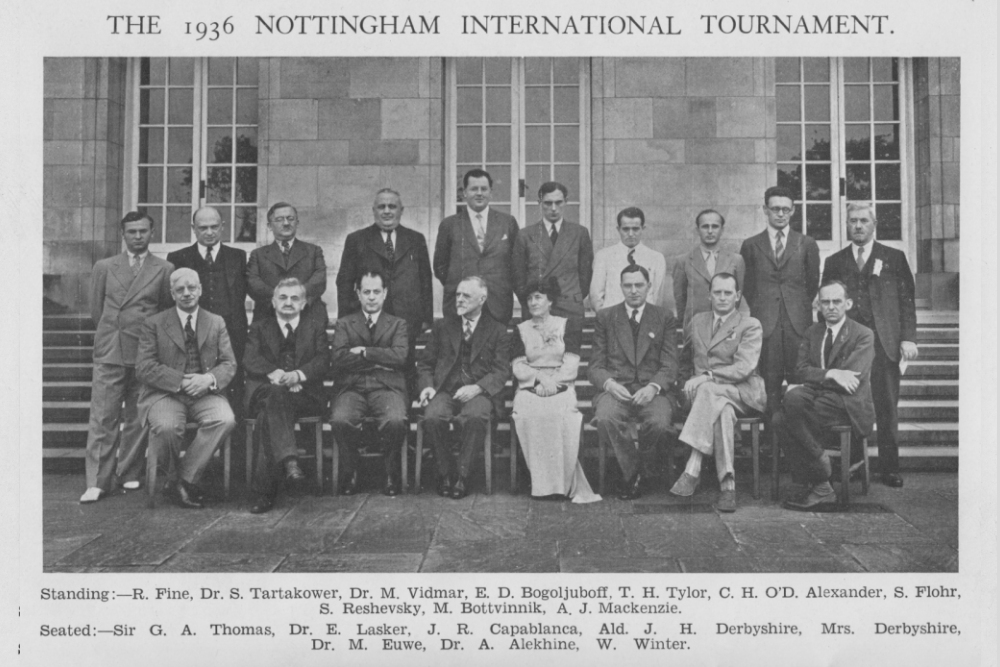
# Nottingham 1936: The Tournament That Showed the Future
The Nottingham 1936 tournament stands as one of the most stacked events chess has ever seen. Five world champions assembled in the same room. Young players arrived hungry. And two titans who had not played each other in nine years, since their 1927 World Championship match, squared off once more.
That reunion alone makes Nottingham 1936 worth studying. Alekhine and Capablanca were the chess world's defining rivalry of the 1920s. Their 1927 match in Buenos Aires was one of the greatest championship matches ever played, with Alekhine retaining his title through sheer will and preparation. By 1936, Capablanca had faded from the championship picture. Alekhine still held the crown. To see them face each other again, in a tournament rather than a match, gave the event an aura of reckoning.
But the real story at Nottingham was deeper than nostalgia. A changing of the guard was underway. The tournament field mixed the old guard with the rising generation. Botvinnik was there. So was Euwe, the man who would take Alekhine's title just two years later. The presence of younger players signaled that the chess world was shifting. The age of the old master was ending. The modern era was beginning.
The tournament also matters because it reveals something about how chess evolved in the 1930s. By this point, the hypermodern revolution had reshaped opening theory. Players like Botvinnik and the younger generation attacked the center indirectly, rejecting the classical 1.e4 and 1.d4 symmetry that had dominated for decades. Nottingham 1936 would have shown these new ideas in action at the highest level.
What makes Nottingham 1936 exceptional from a historical record perspective is almost accidental. Film footage from the event survived. Photographs exist. These are not common for tournaments from this era. Most games from the 1920s and 1930s are known only through notation in old magazines and books. But Nottingham left a visual record. You can watch these players think. You can see their mannerisms, their posture, the way they approached the board. That footage is invaluable for understanding the chess culture of the time.
The tournament also sits at a fascinating boundary in chess history. It occurred just three years before the Second World War. The next few years would fracture the chess world. Players scattered across continents. Soviet chess was on the rise, though still not dominant. European chess was about to convulse. Nottingham 1936 captures world chess at a moment of peace and transition, before everything changed.
For anyone interested in how the game evolved from the classical era into the modern one, Nottingham 1936 is required study. The games show tactical mastery you expect from world champions, but also the new strategic ideas that would dominate the second half of the century. The presence of five former or current world champions in one tournament raises the level of analysis. Every game matters. Every decision is the work of the absolute elite.
The tournament deserves more attention from contemporary players and historians. It bridges the Capablanca era and the Botvinnik era. It shows Alekhine and Capablanca one last time. It demonstrates the hypermodern school in its full maturity. And it exists on film, which means you do not have to imagine what happened. You can watch the masters sit down and play.