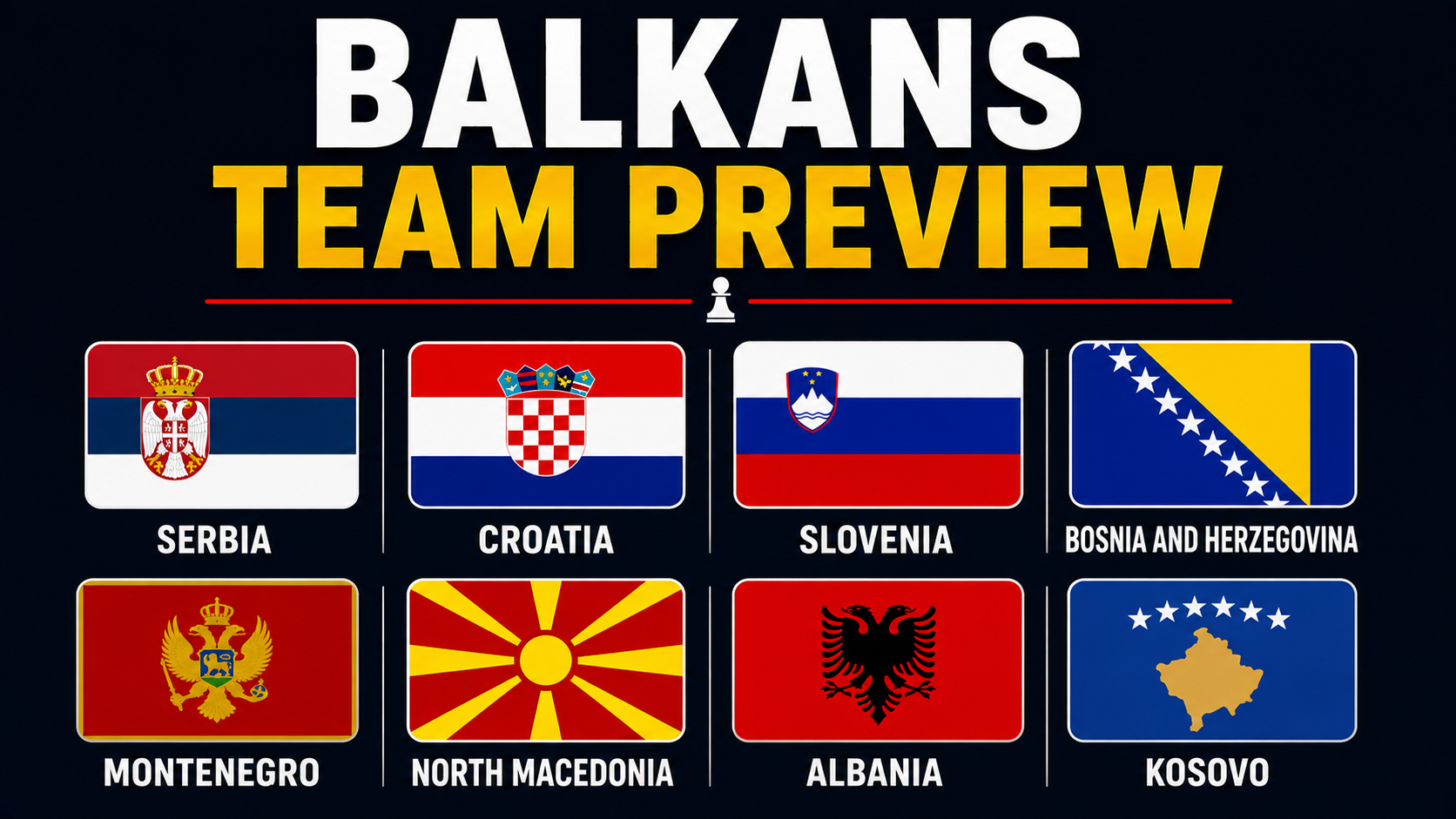
# Balkans Emerging as Olympiad Powerhouse with Historic Family Presence
Kosovo's Saraci family will make history at the 2026 Olympiad. Four siblings competing across both the Open and Women's competitions represents the kind of breakthrough moment that transforms a federation's trajectory in international chess. Nderim Saraci, an International Master, leads Kosovo's charge on the Open side alongside his brother Korab (Candidate Master), while sisters Rinesa and Ndriqona represent Kosovo in the Women's event. This is not merely a feel-good story. It signals that Kosovo chess has developed the depth and family infrastructure to compete at scale.
The broader Balkans region arrives at the Olympiad with genuine competitive teeth. Serbia and Croatia field all-grandmaster Open teams seeded 16th and 17th globally, placing them squarely in medal contention. That's not aspirational talk. That's field position. Neither federation is showing up to participate. Slovenia rounds out the trio of heavyweight challengers, deploying four grandmasters led by Vladimir Fedoseev, who rates 2693 and stands as the highest-rated player in this entire eight-federation batch.
This concentration of strength matters tactically. The Balkans occupies a strange middle tier in world chess. Too strong to ignore, too regional to dominate the tournament narrative. Serbia has decades of pedigree. Fedoseev brings Yugoslav-school training filtered through the Russian system. Croatia has climbed steadily. But none of these teams threatens China, India, or the American depth charts. They will battle for European honors and board positioning within their sections.
Kosovo's emergence shifts the calculus. A federation that barely existed as a chess entity a decade ago now plants four players into an Olympiad. The Saraci siblings carry weight beyond their rating points. They represent viability. They show younger players in the Balkans that international success isn't locked behind arbitrary borders. That matters for recruitment, for federation building, for the pipeline.
The real test arrives during the event itself. Family representation guarantees nothing on the board. Nderim Saraci's IM title suggests serious caliber, but the Open competition at an Olympiad eliminates sentiment instantly. The Women's competition adds another layer. Rinesa and Ndriqona compete in a field where rating inflation is real and board strength varies dramatically by federation. Kosovo's Women's rating pool sits lower than Serbia's or Slovenia's established academies.
Expect Serbia and Croatia to compete hard for European medals. Watch Fedoseev on board one for Slovenia. But keep your eye on Kosovo's boards, particularly how the Saraci brothers navigate the Open field. That's where you'll see whether this family story becomes a federation renaissance or remains a memorable anomaly. The Balkans will deliver both raw strength and genuine intrigue.