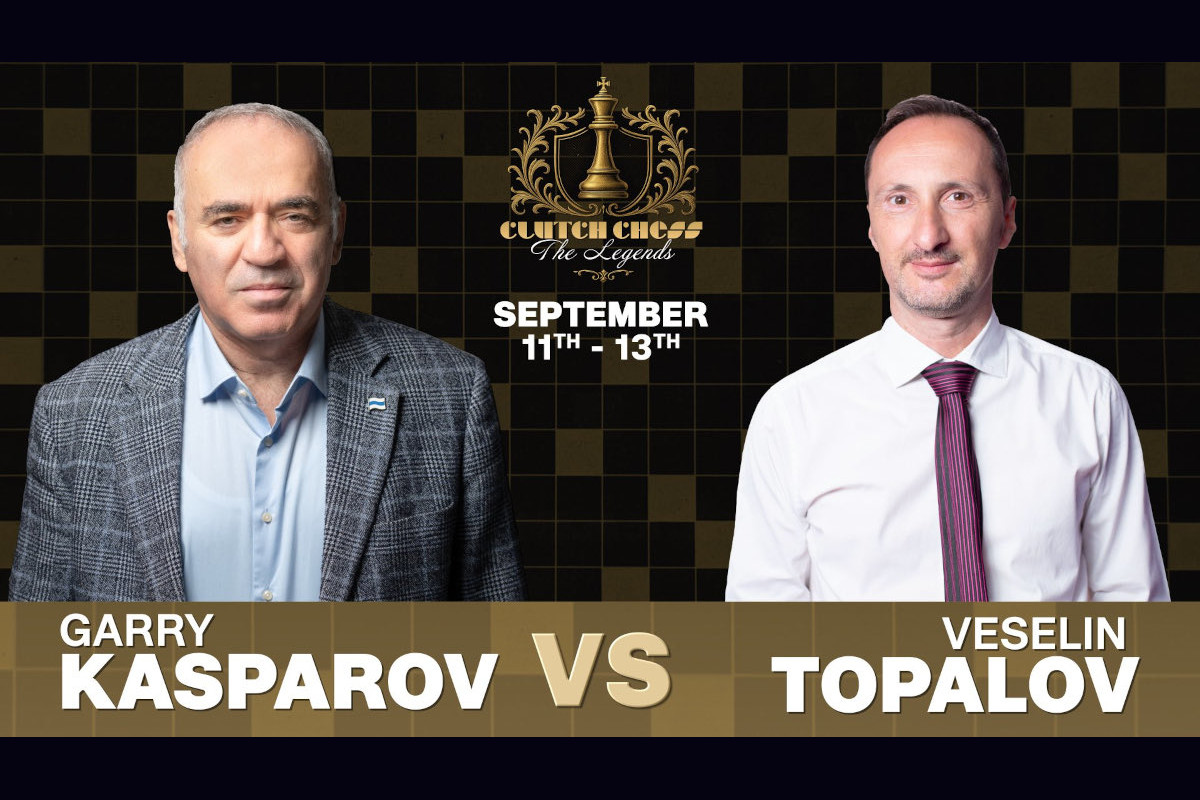
Kasparov and Topalov are meeting in Saint Louis for a chess960 match. This matters because the two men define different eras of chess, and chess960 strips away the prepared openings that shaped their rivalry for decades.
The match runs September 11-13 at the Clutch Chess: The Legends event. Twelve games total. The scoring structure escalates each day, meaning wins on the final day carry more weight than wins early. This format rewards aggression and creates pressure exactly where you'd want it in a comeback match.
This is Kasparov's second consecutive legends match. He beat Viswanathan Anand in 2025, proving the former World Champion still has match mettle at a level most players never reach again. Now he faces Topalov, a player he's known in multiple competitive forms across multiple decades.
The history between these two runs deep. Kasparov and Topalov last played a chess960 match in Saint Louis in 2018. That encounter tested both men under the variant format, where preparation evaporates and over-the-board calculation dominates. Chess960 removes the theoretical knowledge gap that plagues retirements and makes rapid game assessment brutal for anyone without sharp tactical instincts. Kasparov's tactical gifts never left him. Neither did Topalov's.
Why chess960 for a legends match? The format levels the field against preparation-heavy advantages. A 68-year-old Kasparov cannot outprepare anyone. He cannot study deeper lines or memorize the latest novelties. But he can outthink them in real time. Chess960 invites that kind of chess. Position sense, calculation speed, and pattern recognition trump database knowledge. These are the skills that made Kasparov the dominant force for fifteen years and Topalov the only man to seriously threaten that dominance at its peak.
The psychological dimensions matter too. Topalov represents Kasparov's era of genuinely universal chess competence. Topalov played Kasparov during Kasparov's active world championship years. He never dethroned him. That relationship carries weight when they meet at this stage of life, both removed from the professional circuit by years or decades, both still hungry enough to show up.
Saint Louis has become the premier venue for these encounters. The Chess Club there hosts serious matches and tournaments. It offers the infrastructure and the chess-literate crowd that understands what's happening at the board. Kasparov versus Topalov in chess960 is not casual entertainment. It draws viewers who know the history, respect the players, and care about the chess itself.
The escalating point structure changes strategy. Early games feel less critical. A loss on day one stings less than a loss on day three. This invites risks that a flat-point system would discourage. Kasparov might play sharper early if a loss doesn't doom him. By the final day, every game becomes a referendum. Players shift toward solidity or all-out assault depending on the match state.
For Topalov, this is a chance to prove the 2018 Saint Louis encounter was not a fluke and that he still belongs in the conversation with the absolute elite. For Kasparov, it's another opportunity to cement his status as the only true universal chess talent, capable of competing at any format, any time, any era.
Both men are past their peak rating years. Both played some of the most beautiful attacking chess the game has ever seen. Chess960 lets that attacking chess breathe again because preparation cannot drown it out. They will have to think, calculate, and execute under time pressure without a safety net of pre-game analysis.
Saint Louis awaits. September will show whether the old guard still has the reflexes.