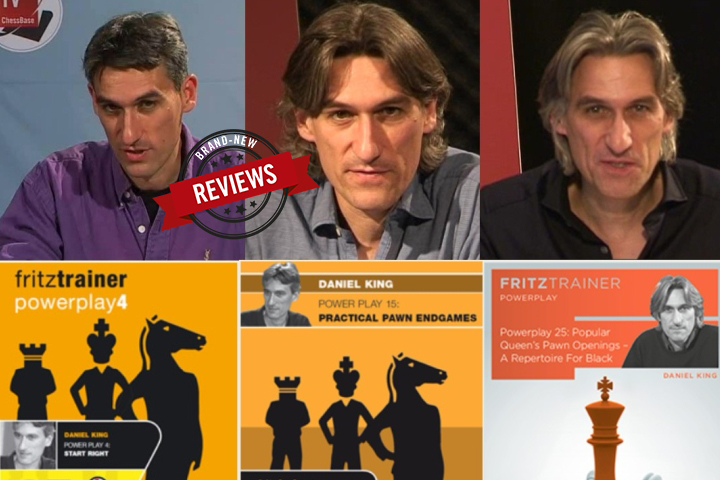
# Daniel King's Power Play Series Still Relevant After a Decade and a Half
Daniel King's Power Play collection stands as one of the longest-running and most comprehensive training video series in chess education. Between 2007 and 2020, ChessBase published 28 volumes under this banner, creating what amounts to a detailed map of how strong players should think about the game.
The series works because King refuses to treat chess instruction like a textbook. Instead, he builds from pattern recognition. A club player studying Power Play learns to spot tactical opportunities the way a master does, not by memorizing combinations but by understanding the structural conditions that make combinations possible. The same applies to his attacking play modules, which don't hand you blueprints so much as teach you how to recognize when an attack actually works.
What makes the Power Play collection endure is breadth paired with depth. King covered tactics, of course. Every serious player needs that. But he also devoted volumes to attacking play, defensive technique, and endgame methodology. These are the unglamorous parts of chess that actually separate 1600 players from 2200 players. Many instructors skip them because they're harder to make entertaining. King didn't.
The opening material deserves separate mention. Rather than flooding players with variations, King's Power Play opening volumes establish the underlying ideas. Why does White play this move here? What is Black trying to achieve? A player who understands the logic of an opening adapts far better than someone who memorized lines and ran into a novelty on move 18. That philosophy has proven durable even as opening theory has accelerated since 2020.
Jochen Schwarz, a Bremen club player, recently reviewed the entire collection. His work matters because he's the actual intended audience. Not a grandmaster. Not someone playing 10 games a week. A regular player with limited time asking whether these 28 volumes justify the investment.
The answer matters now more than ever. The chess training landscape has fractured. You can watch YouTube videos for free. You can subscribe to ChessBase Play+ or Chess.com Premium for daily lessons. You can hire a coach on Lichess or Chess.com. You can buy individual books or PDF courses. You can train with engines directly. For club players deciding how to spend money and time, the question isn't whether Power Play contains good material. It's whether good material from 2007-2020 still beats free alternatives.
King's content has aged well because fundamental chess principles don't change. A weak back rank in 2008 was a liability. It still is. A rook endgame with opposite-colored bishops requires the same logic today. Positional sacrifice concepts that King taught remain valid even as engines have rewritten some opening assessment.
Where Power Play shows its age is in opening theory. Chess at the elite level moved forward. Positions that looked drawish in 2015 might have computerized refutations discovered by 2024. A club player preparing the Catalan based on King's 2012 volume won't hit the sharp theoretical lines where elite players battle, but club-level opponents probably won't either. The disadvantage exists mainly if you're playing serious rated tournaments where your opponents have studied the same lines with more recent computer assistance.
The tactical and middlegame material holds up without reservation. Training your eye to see backward moves, clearance sacrifices, and X-ray tactics works in 2024 exactly as it worked in 2007. The patterns are universal.
For club players with $200-300 to spend on chess education, Power Play competes well against newer video series. It doesn't trend on social media. It lacks the flashy production values of modern content. But it delivers systematic, thorough instruction from someone who understands how to teach the game to people who don't play for money.
The real question isn't whether Power Play is good. It's whether you learn best from video instruction at all, or whether you'd benefit more from hiring a coach, studying master games in depth, or simply playing more games. That's a choice no review series can answer for you.