# Robert Ris Returns with Calculation Courses That Go Beyond the Obvious
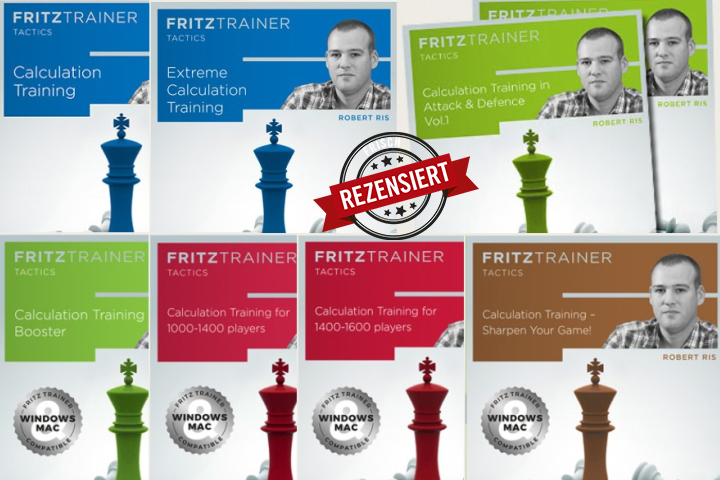
Robert Ris has spent years building a reputation for teaching chess players how to actually think at the board. His newest batch of Fritz Trainer modules expands on work he started back in 2018, when he released "Calculation Training", a course that tackled the gap between knowing theory and finding the right move when it matters.
The problem Ris identified then remains the problem now. Most chess instruction focuses on what to play, not how to play it. Theory teaches you the opening framework. Endgame manuals show you the tablebase wins. But concrete calculation, the moment-to-moment business of analyzing variations three, five, or ten moves deep and spotting which line actually works, stays elusive for most players below elite level.
That distinction matters because it determines how you advance. A 2200-rated player can memorize the Najdorf Sicilian to move twenty. But without the ability to calculate accurately when the position deviates from theory, that preparation evaporates. Ris builds his courses around this reality.
The new modules build on the 2018 foundation. Each targets a different cognitive skill. Some focus purely on tactical calculation, where the answer is binary: mate in three or it isn't. Others address strategic calculation, where you evaluate positions that look roughly equal and decide which one you actually want to play.
The distinction is worth understanding. A tactical problem gives you clear endpoints. You calculate whether your attack works or it doesn't. Strategic calculation is messier. You might have three legal moves that all avoid immediate tactics. Your job is to calculate deeply enough to understand which position offers better winning chances or holds better drawing resources.
Ris structures his courses so players can self-assess. You work through positions at your level, get immediate feedback, and measure your progress. This beats passive video consumption, where you watch a grandmaster solve a problem and nod along, telling yourself you would have found it too.
The courses are modular. You don't need to work through them sequentially. A 1900-rated player drilling basic calculation patterns can skip the advanced strategic modules. Someone preparing for their first over-the-board tournament might focus on the mid-level courses that address the specific positions they'll face. A 2400-rated international master reviewing for a world championship qualifier would start with the hardest material.
This structure reflects how calculation ability actually develops. It's not like opening preparation, where you follow a tree from the first move to move fifteen. It's closer to how you build visualization skills, where each correctly evaluated position makes the next one slightly easier to see.
The original "Calculation Training" from 2018 succeeded because Ris didn't pretend calculation is taught in a lecture. You learn calculation by calculating. By working through positions repeatedly. By failing on position X, reviewing what you missed, and then getting position X right the next time you encounter it.
The new courses scale this up. They add more positions, more complexity, more strategic depth. They also add recorded analysis from Ris himself, walking through positions where students commonly make errors and explaining not just what the right move is but why the intuitive move fails.
The timing makes sense. Chess engines have gotten stronger, making it easier to generate positions that are difficult for humans but not absurd. A position that stumped Carlsen in a blitz game can now be extracted, verified as genuinely complex, and packaged into a training module. Ris uses this approach instead of relying on hand-picked classical games, which tend to be either too simple or contrived.
The multipart review planned by Lukas Koepl suggests the module set is substantial. Rather than a single course of 50 positions, these appear to be multiple courses covering different calculation domains. That's smart pedagogy. A course on sacrificial calculation demands different positions than a course on endgame calculation, where you're counting moves to promotion against defensive resources.
For ambitious players below the grandmaster level, these courses address the actual bottleneck. Most 2200 to 2400 players don't fail because they lack theoretical knowledge. They fail because they miscalculate a tactical sequence or miss that a strategically superior position was actually lost due to a hidden tactic three moves away. Ris builds tools that target exactly that weakness.
The courses represent the kind of practical chess instruction that's often overlooked. It's not glamorous. It won't make a viral video or get quoted in mainstream outlets. But it's what separates strong club players from tournament regulars, and tournament regulars from titled players.