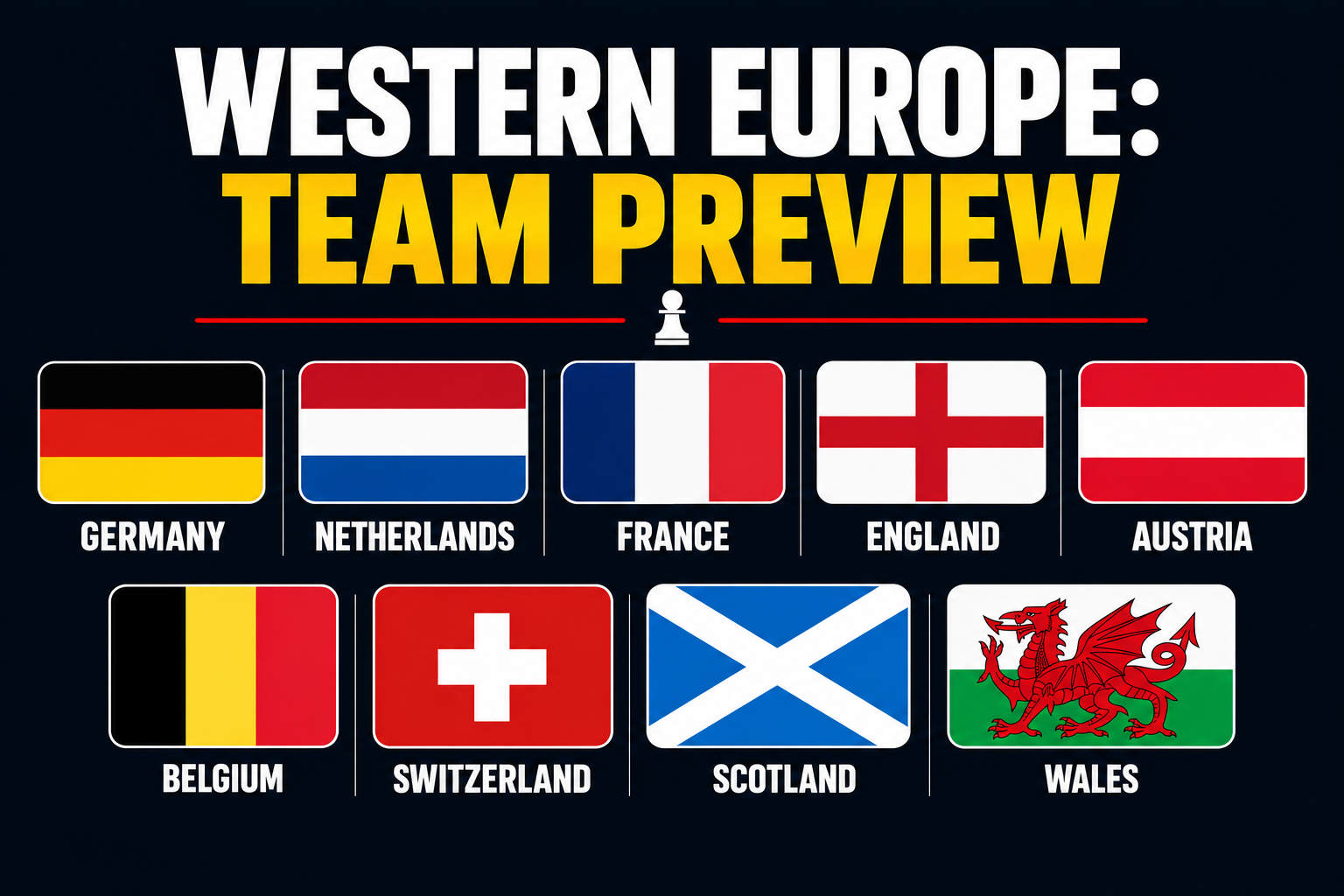
# Western Europe's Grandmaster Class Dominates 2026 Olympiad Draw
Germany fields the tournament's highest-rated player in Vincent Keymer, who sits at 2764. He anchors a complete five-grandmaster Open roster that includes Frederik and Rasmus Svane. The Dutch bring Anish Giri alongside the Van Foreest siblings across their Open and Women's lineups. France and England round out the regional powerhouses, each with full GM squads. All four nations rank inside the tournament's top twelve seeds overall.
This concentration of top-tier talent in Western Europe shapes the medal race fundamentally. Unlike previous Olympiad cycles where strength scattered across regions, 2026 bunches the world's deepest player pools in one geographic bracket. That matters for seeding, for early-round momentum, and for which teams accumulate rating points fastest.
Keymer's inclusion signals Germany's continued investment in maintaining its Open team supremacy. At 2764, he's not just the region's strongest player. He's playing in an era where the rating spread between position one and position five on a national roster determines match outcomes at the highest level. The Svane brothers provide stability; Frederik and Rasmus have both proven themselves repeatedly at Olympiad level. This is a roster built to win, not survive.
The Dutch structure differs strategically. Pairing Giri with the Van Foreests creates a hybrid Open-Women's dynamic. Anish Giri remains the Netherlands' best player and their primary draw at the board one level. But spreading the Van Foreests across both competitions acknowledges depth. The Women's team strengthens; the Open team maintains competitiveness without overloading it.
France and England each face the same pressure: win the regional bracket or fade into the broader tournament. Home continent matches rarely produce upsets, but they do expose weaknesses. If Germany's Keymer-Svane combination clicks, they'll clear Western Europe early. If either cracks, England or France pounces.
Switzerland's Women's team entry confirms the Olympiad's expanded female participation at regional level, though the source cuts short before full details emerge. This points toward growth in mixed-gender competition, a trend that accelerated post-2020.
The real story emerges during board one pairings. Keymer versus Giri alone justifies premium coverage. Add the Svane-Van Foreest matchups, factor in French and English top boards, and Western Europe becomes the tournament's primary narrative crucible. By round three, the medal trajectory crystallizes based on who controls these internal clashes.
This isn't a weak region hiding behind seeding luck. This is chess's historical depth zone proving it still matters.