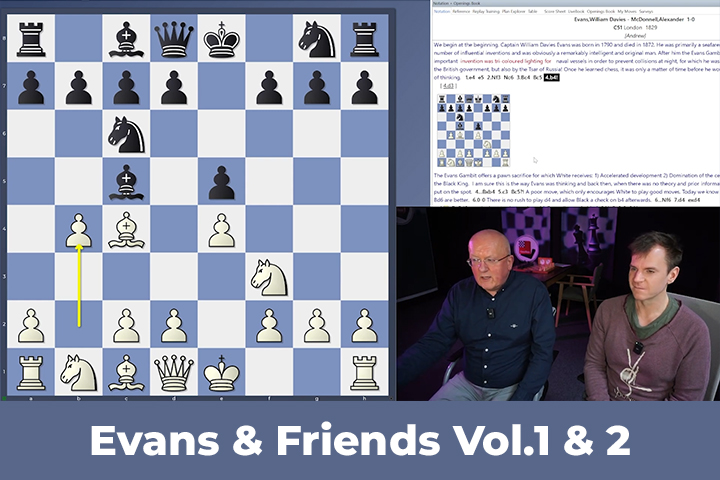
The Evans Gambit never went away. It just fell out of fashion.
Andrew Martin's new course on the opening proves something that club players have always known but engine theorists keep forgetting: sacrificing a pawn early for tempo, space, and a mating attack works at most levels of the game. It works especially well when your opponent sits below 1800, has limited preparation, and faces the kind of sharp tactical complications that computers love to analyze but humans hate to play.
Martin's argument rests on a practical observation. The Evans Gambit, which starts 1.e4 e5 2.Nf3 Nc6 3.Bc4 Bc5 4.b4, abandons the pawn to open lines toward Black's king. White gets the bishop pair, open diagonals, and central pressure. Black gets a material advantage that means nothing if White delivers checkmate first. For a 1600-rated player facing an opponent who memorized three moves of some closed Ruy Lopez sideline, this is a feature, not a bug.
The historical game by William Davies Evans, the Irish clergyman who invented the line in the 1820s, serves as Martin's template. The opening bears Evans' name because he played it successfully for decades, proving that the idea had teeth. Modern engines initially dismissed it as unsound. AlphaZero and Stockfish suggested Black could consolidate and convert the extra pawn. But that analysis assumed perfect play, which exists only on silicon.
What changed is not the evaluation. It is the understanding of what happens next.
Magnus Carlsen faced the Evans Gambit in recent games and treated it seriously. Not as a novelty. Not as something to refute. As a legitimate threat requiring respect and precise defensive knowledge. When the world's highest-rated player accepts the gambit and plays for the win rather than declining it outright, it signals something: the opening still poses practical problems. Carlsen prepared for it. He did not dismiss it.
This matters for club players because it inverts the usual chess pedagogy. Most opening courses teach the main lines, the theoretical continuations, the variations that appear in the Elo 2700 games. The Evans Gambit teaches something different: dynamics beat credentials. A well-timed attack from an unexpected opening demolishes the player who relies on preparation alone.
The tactical vision component Martin emphasizes is the real value here. Playing the Evans Gambit forces both sides to calculate variations rather than follow a plan. Black cannot simply trade pieces and reach a comfortable position. White cannot afford a passive setup. Every move involves concrete calculation, forcing sequences, and immediate tactical consequences. A 1600-rated player who develops this skill will gain rating points across their entire repertoire, not just in the Evans.
The opening also scratches an itch that modern chess has created. Tournament chess above the amateur level increasingly features long strategic battles, prophylactic moves, and grinding positions where a quarter-pawn advantage suffices to win over fifty moves. This is excellent chess. It is not fun. The Evans Gambit offers a stylistic alternative. It says: you can play chess in a different language. The language of sacrifice, calculation, and attack.
Carlsen playing it is the headline. But the deeper story is that club players have always known something that theory had to relearn. A gambit is dangerous if it works. The Evans works often enough that it remains in the toolkit of serious attacking players at every level.
Martin's course fills a gap. Not in theory, where the Evans has been analyzed to death. But in practical knowledge and tactical training for the players who will actually use it. The opening is not the easiest path to victory. It is not the objectively best move in the computer sense. It is the move that puts the opponent in an uncomfortable position, forces them to defend accurately, and gives you a real chance to outplay them.
That is all a dangerous weapon needs to be.