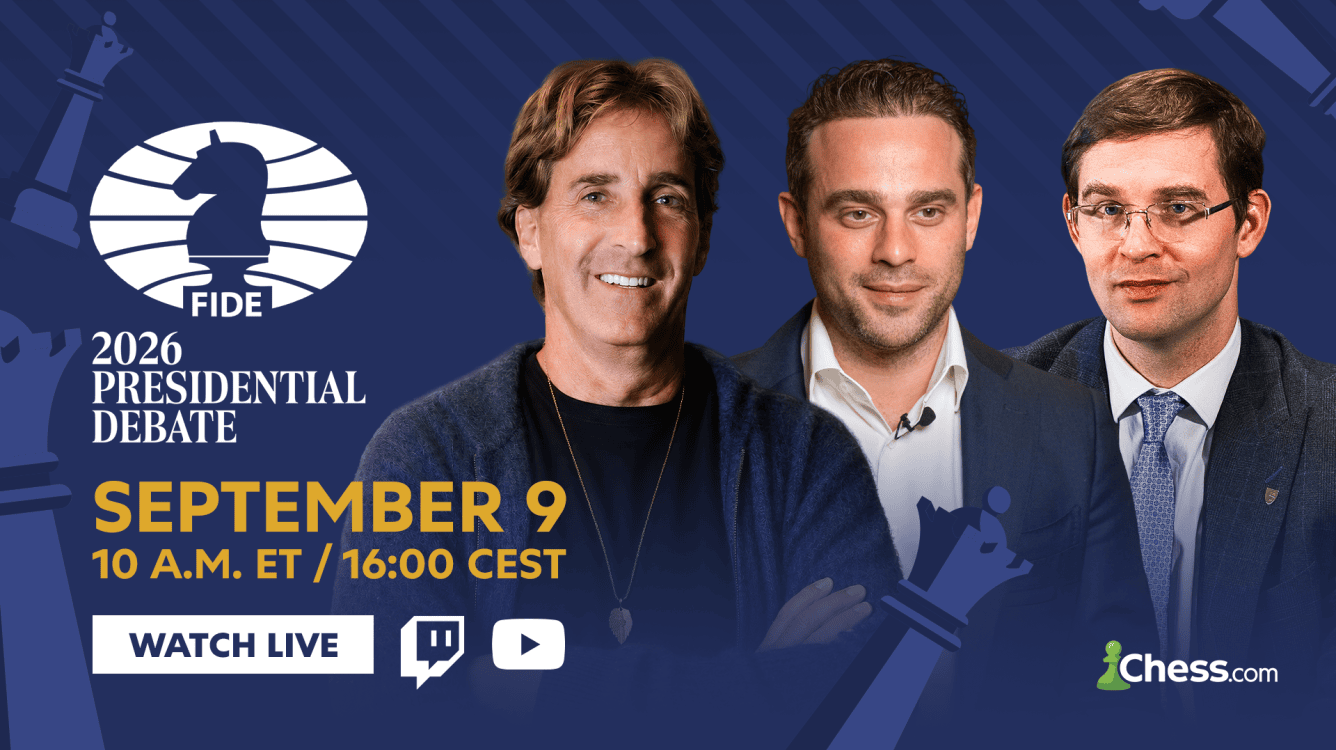
The 2026 FIDE presidency race turned confrontational before it truly began.
Chess.com's September 9 debate, moderated by Grandmaster Maurice Ashley, promised a three-way clash between Jan Henric Buettner, Timur Turlov, and Wadim Rosenstein. It delivered something messier. Rosenstein delivered his opening statement, then largely stepped aside, leaving Buettner and Turlov to prosecute competing visions for the world's chess federation.
This wasn't a technical malfunction or scheduling issue. The debate's structure, or lack thereof, exposed real fractures in how the candidates see FIDE's future. Buettner and Turlov spent the bulk of the broadcast articulating their platforms directly against each other. Both zeroed in on three core problems: FIDE's professionalization, financial sustainability, and its relationship with member federations.
Buettner's pitch centered on modernizing FIDE's internal operations. He argued the federation has bloated bureaucracy that wastes resources meant for grassroots development and competitive infrastructure. His case relied on specifics about budget allocation and administrative streamlining. Turlov countered with an emphasis on commercial growth. He believes FIDE can't solve its structural problems without access to meaningful capital, which requires partnership with the private sector. He named Chess.com as an obvious model for how digital platforms can fund competitive chess at scale.
The absence of Rosenstein's voice throughout most of the debate raises questions about his campaign's readiness or his appetite for this fight. A viable third candidate should have used prime-time exposure to differentiate himself. Instead, he became a footnote to Buettner and Turlov's argument.
What this debate revealed is not technical chess politics, but a genuine ideological split. Buettner represents the efficiency-and-governance camp. Turlov represents the growth-through-capital camp. These aren't compatible visions. One emphasizes doing more with careful management. The other emphasizes doing more by attracting investment.
For FIDE's member federations, this distinction matters enormously. A Buettner presidency likely means tighter budgets and higher operational standards. A Turlov presidency likely means more funding available but with strings attached to commercial interests. Neither candidate explicitly addressed how they'd balance development for smaller chess nations against the needs of elite players and major federations.
The debate format itself may have been the real loser. A one-sided broadcast between two candidates obscures the third option. But it also clarified where the actual contest lies. Buettner and Turlov are fighting for FIDE's soul. Turlov's argument has momentum in a world where chess has suddenly become commercially viable. Buettner's argument is more cautious and appeals to traditionalists who distrust corporate influence.
The second debate, if it happens, needs all three candidates engaged. Otherwise FIDE voters won't see the full range of options before they cast their ballots.