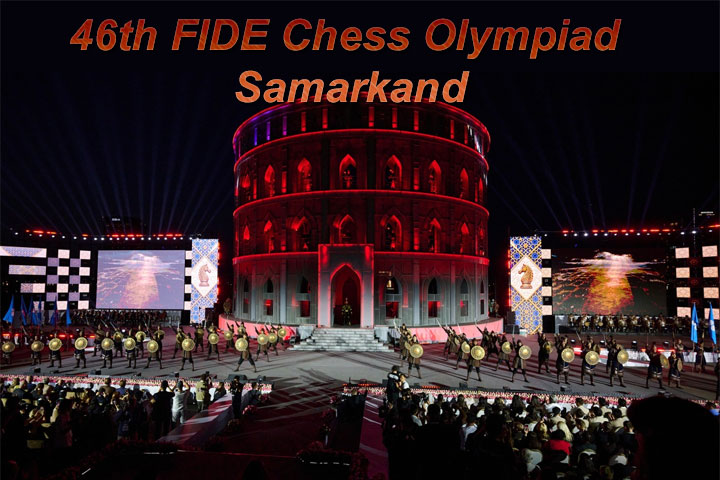
# Samarkand Delivered Theater Chess Never Expected
Michael Rahal has worked the biggest stages in chess. World Cups. Olympiads. He stood in Barcelona during the actual 1992 Olympic Games opening ceremony. Yet he walked out of Samarkand this week saying he had never seen anything like it.
That matters because Rahal does not exaggerate for a living. He is the FIDE Press Officer. His job is to report what happens, not to hype it. When he says an opening ceremony in Uzbekistan eclipsed decades of major chess events, something genuinely exceptional occurred.
The ceremony took place in Samarkand, one of the ancient Silk Road cities. FIDE chose the location deliberately. The organization has been pushing chess into regions beyond the traditional European and American strongholds. Moscow. St. Petersburg. Cancun. Dubai. Each venue carried political or commercial weight. Samarkand signals something different: a return to history, to the roots of intellectual exchange, to a place where the game itself once traveled across continents.
What made this particular evening stand out remains the open question. Opening ceremonies blend music, choreography, national pride, and the formal business of seated players. Most chess people endure them. They are long. They delay the tournament. Even spectacular ones become forgettable within a week.
Rahal's assessment suggests Samarkand broke that pattern entirely. He is comparing it not just to other chess ceremonies, but to actual Olympic opening ceremonies he witnessed in person. That is a staggering bar. The Barcelona Olympics in 1992 involved years of planning, massive budgets, world-class directors. And Samarkand matched or exceeded the impact.
The chess community thrives on drama, but it typically unfolds across the board. Games produce the narratives. Blunders sting. Sacrifices shock. Endgame escapes exhilarate. Off-board spectacle usually feels secondary. Yet Samarkand's organizers appear to have understood something: chess at this level is as much about culture and occasion as it is about tactics and strategy. They created an experience, not just a tournament.
This carries implications for FIDE's long-term vision. Arkady Dvorkovich and his team have invested in making chess tournaments into genuine events. The Chess Olympiad in Bangkok. The Candidates Tournament rotating through various cities. The World Championship venue selection. Each one receives ceremony, media attention, cultural investment. Samarkand represents the logical extension of that philosophy.
The venue also matters geographically and politically. Uzbekistan has entered chess at the elite level through investment and player development. Uzbek players compete regularly among the world's elite. By hosting a major event in Samarkand, FIDE legitimizes the country as a chess power and signals that the game's future extends beyond traditional strongholds.
For players attending, the atmosphere shapes preparation and performance. A tournament preceded by genuine spectacle, by cultural celebration, by the sense that something historically significant is occurring, changes how competitors approach their games. It lifts the event above routine. It makes drawing less tempting when the entire nation has invested in your presence.
The specific tournament in Samarkand remains to be detailed in terms of format, participants, and schedule. But Rahal's reaction serves as a reliable indicator: something real happened there. Not manufactured enthusiasm from FIDE marketing departments. Not polished but forgettable pageantry. An actual moment that surprised someone who has witnessed world-class ceremonial events for decades.
That does not guarantee tournament success or lasting memory. The actual chess will determine that. But Samarkand entered the night with at least one thing already accomplished. It proved that chess can move beyond the European hotel ballrooms and university auditoriums where it typically lives. It proved that the game belongs in historic cities, on grand stages, treated as the cultural force it actually is. And it impressed someone who does not get impressed easily.