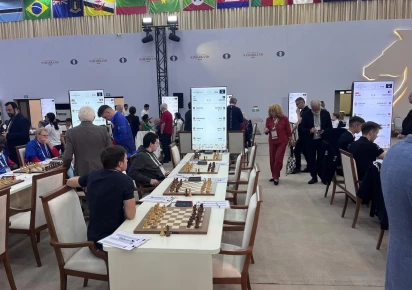
Pakistan's chess federation forfeited the nation's opening match at the 46th Chess Olympiad in Samarkand by refusing to field a team against Israel. All four boards sat empty. Israel collected a clean 4-0 walkover without moving a single piece.
This wasn't a scheduling mishap or a player illness. Pakistan's federation president cited explicit government policy as the reason. The Pakistani government does not recognize Israel as a state, and that non-recognition extends to competitive chess. When the Swiss-system pairings drew these two federations together in Round 1 of the Open section, Pakistan's leadership made a political calculation. Playing was impossible under their government's directives.
The consequence is brutal in Olympiad terms. Switzerland-system tournaments reward results, not principle. Israel gained four rating points across their board lineup without playing a single move. Those points count. Those points matter. Pakistan's top players sat on the sidelines while their Israeli counterparts logged unearned victories that will show in Elo calculations and national team standings.
This puts Pakistan in an impossible position going forward. They remain in the tournament, which means additional pairings against Israeli teams in later rounds become possible. Will Pakistan forfeit again? A second 4-0 loss compounds the damage. The math becomes unforgiving fast in a 14-round Olympiad. Yet continuing to play after the first forfeit risks internal political backlash.
The precedent matters too. Chess federations operate within FIDE's governance, and FIDE has worked hard to position itself as politically neutral territory where players from hostile nations compete peacefully. The 2022 Chennai Olympiad saw Iran and the United States play each other without incident. Ukraine and Russia faced off across boards in Samarkand itself. Those matchups proved the sport's integrative power.
Pakistan's forfeiture fractures that principle. It signals that chess remains subject to geopolitical pressure, that a federation can use competition as a political statement. Other nations face government hostility toward opponents. Pakistan chose to weaponize it rather than compete.
The question now hinges on how FIDE responds and whether Pakistan's federation modifies its stance over the next two weeks in Samarkand. For Israeli players, the win is painless but hollow. For Pakistani competitors, the damage to their individual ratings and their team's medal chances is real and immediate.