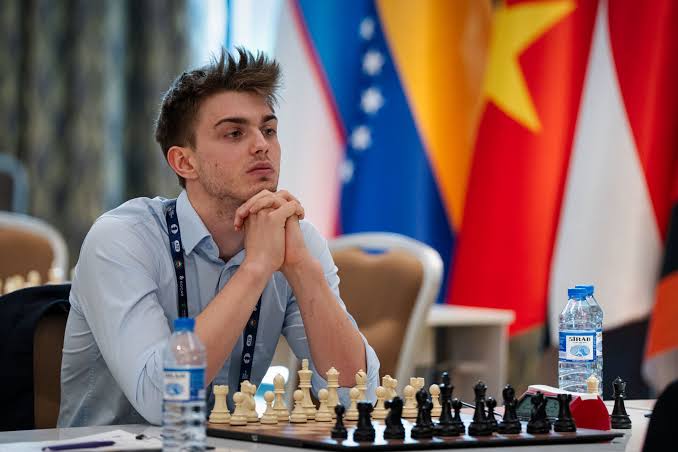
# When Rating Points Don't Matter
Felix Blohberger learned a hard lesson on day one of the Olympiad. The Austrian grandmaster, rated 2552, walked into a trap against Palestine's Ahmad Abdel Wahab and lost clean. Abdel Wahab, a 42-year-old untitled player at 2066, was 486 rating points lower. It didn't matter.
The Nimzo-Indian out of the opening gave no hint of what was coming. The position stayed roughly balanced through the middle game. But around moves 34 to 41, Blohberger's knight ventured too far into hostile territory. On move 41, Abdel Wahab played Nc3, and when Blohberger recaptured with Rxc3, the piece was simply gone. Not hanging, not temporarily sacrificed. Trapped. Blohberger resigned soon after.
This was the kind of result that makes round one at the Olympiad brutal. It is a massive tournament. Rating favorites lose to lower-rated opponents every cycle. But three games from day one stood out for how differently they revealed the nature of rating gaps in practical play.
Blohberger's loss sits at one extreme. He was the heavy favorite. He played reasonably from an opening standpoint. He just made a tactical oversight in the endgame. Abdel Wahab punished him without mercy. There was no miracle, no deep preparation advantage, no opening surprise. Just sound calculation and a mistake.
The Olympiad format brings out these kinds of results more than other competitions. Teams field up to four boards per country. That means not every player is a superstar. You get titled players facing untitled players, super-GMs versus young hopefuls, veterans against rising talent. The rating spread becomes enormous. And when you play enough games, the lower-rated player occasionally gets the position right at the moment it counts.
Blohberger will recover. He is a strong player with thousands of rating points in the bank. One loss in round one, even a bad one, does not define an Olympiad. His team needs points across all four boards, not just his. But Abdel Wahab will remember this. A 486-point upset does not happen often. It happens because someone at 2066 played better chess for seven or eight critical moves than someone at 2552 did on the same day.
That is what the Olympiad teaches every cycle. Rating is predictive. It is not destiny. Blohberger had the higher number. Abdel Wahab had the better position when it mattered.