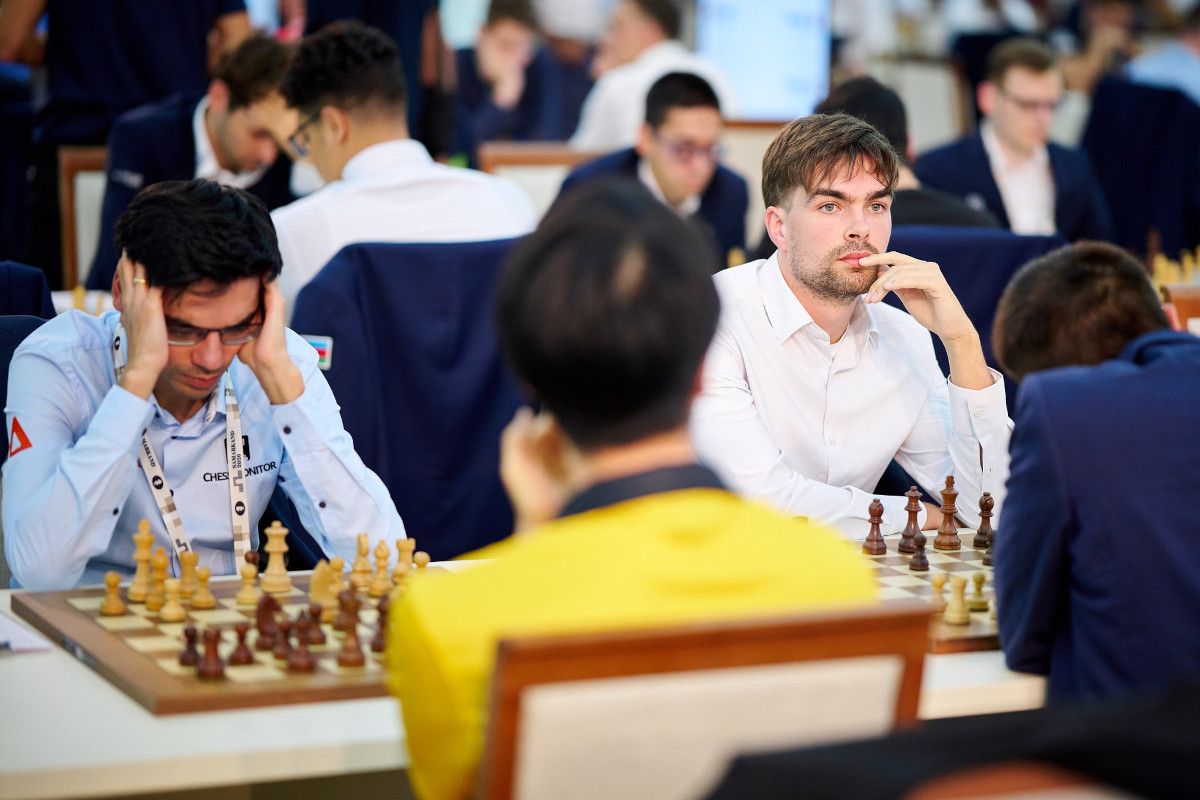
The undefeated bloc at the Samarkand Olympiad is holding, but barely. After three rounds, every top-ten team in the open section remains perfect. That tells you something about seeding strength. That also tells you something about how narrow the margins have become at this level.
The United States, Germany, the Netherlands, Hungary, and Armenia all scraped through 2.5-1.5 victories. Scraped is the operative word. These are not dominant performances by the world's elite. They are battles won on the margin, one or two decisive games anchoring a match where the rating favourites nearly stumbled.
England, seeded 11th, drew with Lithuania. That's a wake-up call for a team with title aspirations. Not a loss, but not a statement either. The English program has the players for deep runs. They do not have separation from second-tier competition yet.
The more dramatic stories belong to Singapore and Kyrgyzstan. Singapore beat Norway. Kyrgyzstan beat Brazil. These are the upsets that define the Olympiad's opening phase. Norway and Brazil came to Samarkand ranked above their conquerors. Rating advantage means nothing once the games start. Singapore executed better. Kyrgyzstan played cleaner chess.
Twenty-one teams enter round four with 6/6 match points, which is absurd in one sense and completely normal in another. The Olympiad has so much depth now that unbeaten records bunch together. In the first three rounds, teams play at roughly even strength relative to their position in the pairings. The real sorting happens in rounds four through nine when the tournament begins to stratify. Top teams face each other. Middle teams cannibalize each other. Lower seeds fight for survival.
The perfect records mean nothing yet. They mean preparation held. They mean no catastrophic blunders. They mean the stronger teams did what they were supposed to do. What matters now is whether the top ten can sustain that perfection when they start facing each other. The draw between England and Lithuania suggests they cannot all remain undefeated much longer.
The path forward tilts toward chaos. Fixtures become meaner. The teams at 6/6 begin to divide into real contenders, serious challengers, and teams that ran hot early. The Olympiad's structure ensures that by round six or seven, the field has sorted itself. Until then, scoreboards will look tidier than chess permits.
Watch how the Netherlands and Hungary respond in round four. Watch whether the American team can convert narrow victories into dominant ones. Watch whether Armenia stays in the conversation or becomes a cautionary tale about seeding strength. The next three rounds will answer whether the opening three rounds meant anything at all.