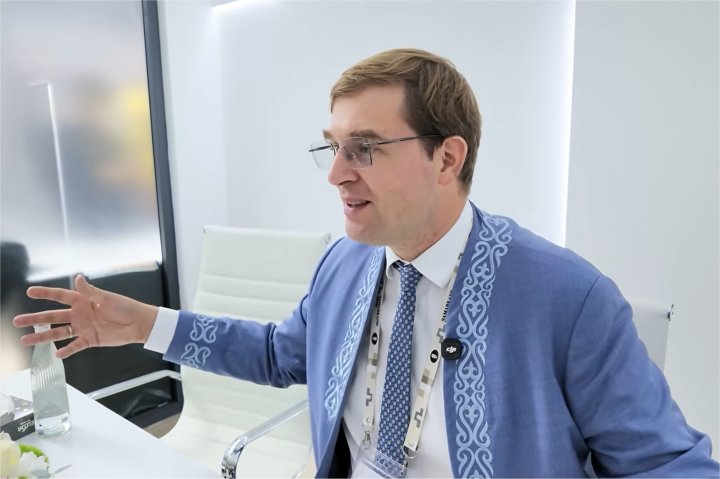
Timur Turlov is not a household name outside Kazakhstan's business circles. But he is running for the most powerful job in international chess. As president of the Kazakhstan Chess Federation and a FIDE presidential candidate, Turlov represents a particular vision of chess: one embedded in national pride, family legacy, and the game's utility as a tool for economic and social development.
His grandfather taught him to play. That matters because it shapes how Turlov thinks about chess now. He did not arrive at the game through tournament ambition or professional coaching. He arrived through inheritance, through a family member deciding that chess belonged in a child's education. That origin story reveals something about his candidacy. He is not selling chess as a vehicle for elite achievement alone, though he certainly values that. He is selling chess as a civilizing force, something families do together across generations.
Turlov's six children reignited his passion for the game in adulthood. This detail is worth taking seriously. Most adults who learned chess as children set it aside. They move on to careers, obligations, competing interests. Turlov did not. His children pulled him back in. That suggests he sees chess not as a phase or a hobby, but as a permanent part of family life. His candidacy for FIDE president, then, carries an implicit message: if chess is important to your family, it should be important to you as a leader. That framing appeals to a constituency beyond the 2700-rated elite. It appeals to parents. It appeals to federations trying to justify chess programs to governments and donors.
The entrepreneurial angle cuts deeper than it first appears. Turlov runs businesses. Chess teaches him something he uses in that work. Pattern recognition, certainly. Long-term planning. The ability to calculate consequences several moves ahead. Risk assessment. These are not new observations about chess and business, but they are not trivial either. When a successful businessman and federation president tells other potential leaders that chess shaped his thinking, he is making a case for chess as infrastructure. Not entertainment. Not art, though it is that too. Infrastructure. The kind of thing governments should invest in because it produces better decision makers.
The support Turlov offers the game, and his stated reasons for that support, matter in the context of FIDE politics. The organization has struggled with funding, governance transparency, and corruption allegations for years. Candidates for the presidency typically arrive with promises of reform. Turlov's approach seems different. He is not primarily attacking the status quo. He is building a narrative around chess as essential to society. That narrative does not require dismantling anything. It requires resources and visibility.
Kazakhstan itself plays a role here. The country has invested heavily in chess over the past two decades. Gata Kamsky's return to competition, the nation's strong showing in recent Olympiads, the hosting of major events like the 2010 World Championship match between Anand and Topalov in Khanty-Mansiysk. Turlov's candidacy represents Kazakhstan's growing influence in global chess politics. He is not just an individual businessman with a passion for the game. He is a representative of a chess nation that wants a seat at the table where international chess decides its future.
What remains unclear is whether Turlov's vision for chess, rooted in family, national pride, and entrepreneurial thinking, will resonate with FIDE's voting delegates. The federation presidency is contested by people with deep experience in competitive chess, professional chess politics, and international sporting governance. Turlov brings business acumen and national backing. Whether that is enough depends on whether delegates believe chess's future lies in elite competition, in mass participation, or in some balance of both.
His candidacy forces that question into the open. That alone makes him worth watching.