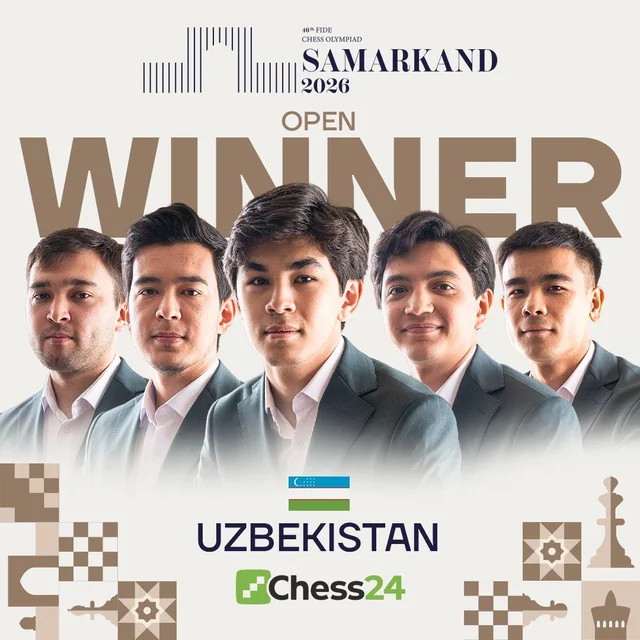
Uzbekistan dominated the 46th Chess Olympiad on home soil, clinching gold in the Open section with a draw against Ukraine in the final round. The Uzbek team of Abdusattorov, Sindarov, Yakubboev, Vokhidov, and Madaminov entered round 14 with an 18-point lead over India and simply executed. They didn't need to win. They needed to not lose. They drew. That was enough.
India's last-ditch push fell short despite beating Hungary. The gap was too wide. Uzbekistan had built such commanding margins through their earlier victories that the tiebreak score, sitting 30 points ahead of India before the final round, rendered a dramatic finish impossible. This is what dominance looks like in team chess. You don't win on the last board on the last move. You've already won weeks earlier.
The victory marks Uzbekistan's second Olympiad gold medal in the Open section. The first came years ago, but this one carries different weight. Winning at home, in the city hosting the event, transforms a title into a statement. Uzbekistan has quietly built one of the world's strongest chess ecosystems over the past decade. Nodirbek Abdusattorov, the youngest member of the team, represents the new generation. Sindarov, Yakubboev, Vokhidov, and Madaminov bring experience and stability. The blend works.
What makes this result matter beyond the medal itself is what it signals about the global hierarchy. India has invested heavily in chess development and produced young talent like D. Gukesh and R. Praggnanandhaa. The push to challenge the Russian school and Chinese expansion in elite chess felt real. But on this stage, at this moment, Uzbekistan executed better. They were more stable. They didn't crack under pressure.
The Olympiad format punishes inconsistency. You can't hide one bad board. You can't rely on a single star to carry you through 14 rounds. Uzbekistan's team played the format perfectly. Solid board one. Competitive boards two through four. Enough depth to grind out results against any opponent.
India's loss doesn't diminish their trajectory. Producing a team capable of pushing for gold at the Olympiad is itself an achievement. But Uzbekistan proved they belong at the very top of team chess. They'll head into their next federation competition with confidence. The rest of the world now knows that Central Asian chess has a serious claim on being the future of competitive chess at the board level.