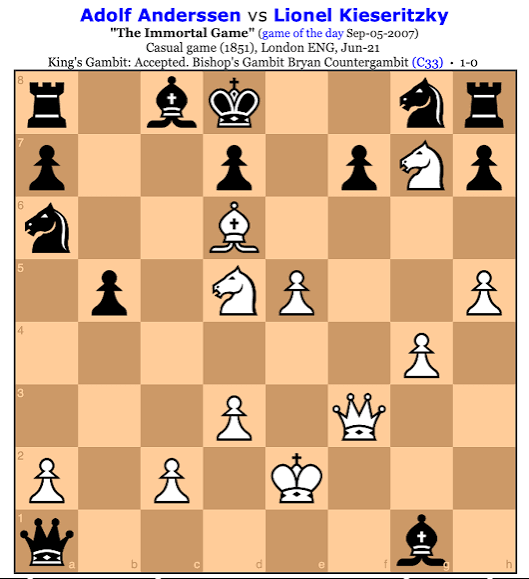
# Why Anderssen's King's Gambit Masterpiece Still Dominates Chess History 170 Years Later
Anderssen's 1851 victory over Kieseritzky in the so-called Immortal Game endures not because of historical accident but because chess players still cannot fully explain why it works. Every generation rediscovers it. Every generation finds something new.
The game matters because it established a template for aggressive chess that still holds. Anderssen sacrificed material repeatedly. He did not calculate all variations to the end. He played on intuition, positional sense, and a willingness to accept counterattacking complications that would terrify most modern players. Yet he won decisively. That victory proved something fundamental: raw attacking power and piece coordination could overcome material deficit if the pieces were organized correctly.
The King's Gambit itself deserves the credit here. By offering the f-pawn, White seizes space and opens lines toward Black's king. Kieseritzky accepted the challenge. He fought back with moves that generated genuine threats. This was not a passive defense but a real battle between two attacking visions. That's why annotators never stopped writing about it. There was real chess being played, not a lecture demonstration.
What changed after 1851 was everything and nothing. The opening fell out of favor after Kasparov played it sporadically and modern computer analysis revealed that Black can hold with accurate defense. But the game's lessons persist. Anderssen demonstrated that piece activity and king safety matter more than counting pawns. He showed that initiative has real value. Those truths never age.
The 1851 game also marked Anderssen as the world's strongest player before Morphy arrived. He won the informal world championship of that era without a rating system, without tournament rating pools, without any of the apparatus modern players use to claim legitimacy. Yet no one doubted his dominance after this game spread. Kieseritzky was strong. London's chess circles knew it. Anderssen beat him in a way that made the verdict look obvious in hindsight.
Players study the Immortal Game for specific reasons today. Attacking players want to understand how to build an assault with sacrifices. Positional players examine how Anderssen maintained control even when materially down. Endgame specialists analyze how he converted his advantage when the pieces came off. Every school of chess finds something.
The game deserves its reputation because Anderssen played it better than Kieseritzky at every critical turn. The sacrifices worked because they were sound, not reckless. The finale came through superior tactical vision, not luck. That combination of correct evaluation and flawless execution is what separates the games we remember from the thousands we forget.