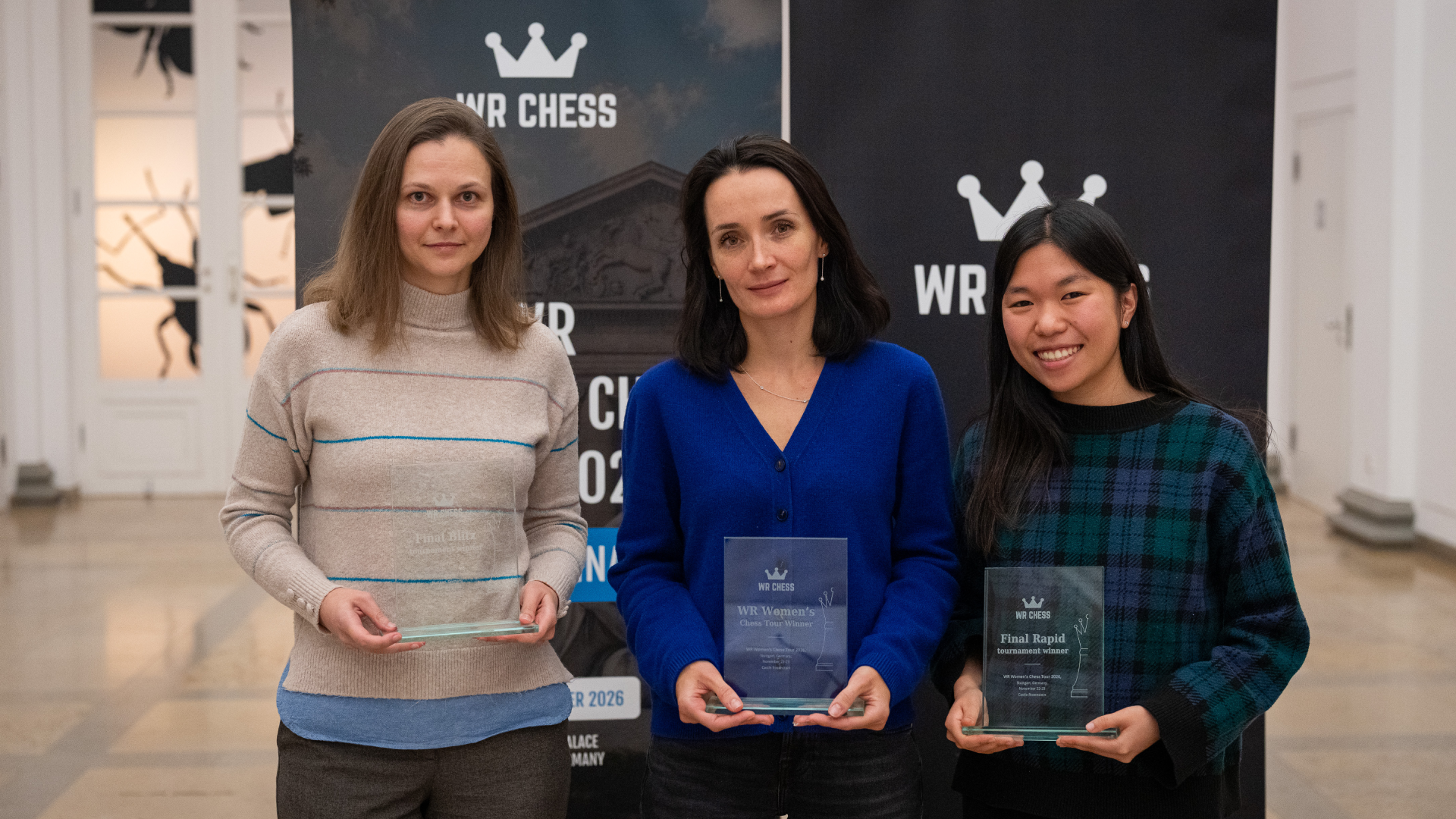
Kateryna Lagno won the first Women's Chess Tour Grand Final despite not winning either rapid or blitz. That alone tells you something about the event's format and how she navigated it.
Lagno clinched the title in the Semifinals. She finished second in the rapid portion, where Jennifer Yip took first. Anna Muzychuk won the blitz segment on Sunday. But second-place finishes across both time controls were enough for Lagno to lift the inaugural trophy.
This is the Women's Chess Tour's capstone event, bringing together the year's strongest performers for a compressed format that tests speed and precision simultaneously. It's Chess.com's attempt to create a women's equivalent to the elite tour structure that dominates the men's side. The 2026 edition marks the first time they've run this Grand Final format, so Lagno's win sets the precedent for what it takes to win the whole thing.
The structure matters here. These events don't crown the person who wins the most games. They award points based on placement across multiple sections. A dominant player who avoids disaster finishes higher than a streaky performer with one monster result. Lagno understood the assignment. She didn't need to blow anyone away in rapid. She didn't need to run through the blitz field. She needed consistency.
Yip's rapid title shows she still possesses the speed that made her one of the world's fastest players to reach the 2500 level. The American has had a solid year on the rapid circuit and proved it again here, though the rapid win didn't translate to overall victory. She'll be disappointed not to convert the first-place finish in one portion into the Grand Final crown, but this result confirms she belongs among the world's elite in time controls below classical.
Muzychuk's blitz victory rounds out the medalists. She picked the fastest time control and exploited it. The Ukrainian has reinvented herself as a rapid and blitz specialist in recent years, dropping classical almost entirely from her tournament calendar. This result validates that choice. She can still win at the highest level when the clock matters most.
The Grand Final format filters out one-dimensional players. You can't survive on classical strength alone. You can't win on speed alone either. The WR Women's Chess Tour structure forces competitors to be complete players, comfortable whether they have five minutes or fifty. That's the point.
Lagno clinching in the Semifinals means she mathematically secured first before the final matches concluded. That's a commanding performance. She didn't need a dramatic finish to know she'd won. The consistent scoring throughout both rapid and blitz had already put the title out of reach for everyone else.
What changes next depends on whether Chess.com runs this Grand Final again and whether they adjust the format based on 2026's results. If Lagno's consistency-wins-tournaments approach repeats, they might consider adding a classical component to prevent the event from becoming purely speed chess. If they want to keep it as a pure rapid and blitz showcase, it's already proven to work.
For the women's tour more broadly, this event fills a gap. The World Chess Championship exists for classical dominance. The Grand Final now gives rapid and blitz specialists their own path to prestige. That's healthy for the game. It means more women can build careers around their actual strengths instead of feeling pressured to prove themselves in classical formats that may not suit their style.
Lagno's victory means she sits atop women's rapid and blitz in 2026, at least by this event's measure. Her rating will improve. Her profile as a complete player gets reinforced. Yip and Muzychuk walk away knowing they can win at this level, which matters for confidence heading into the next tour cycle.
The inaugural champion is Lagno. That matters for history. She gets to define what winning the Women's Chess Tour Grand Final looks like, and she did it without flashiness, through steady excellence across both formats.