Spain's decision to field Alexei Shirov at board four for the 2026 Olympiad tells you everything about where European chess stands. Shirov, who challenged Kasparov for the world title in 1998 and peaked in the 2700s, is still good enough to anchor a top-12 seed's fourth board. That's not nostalgia casting. That's depth.
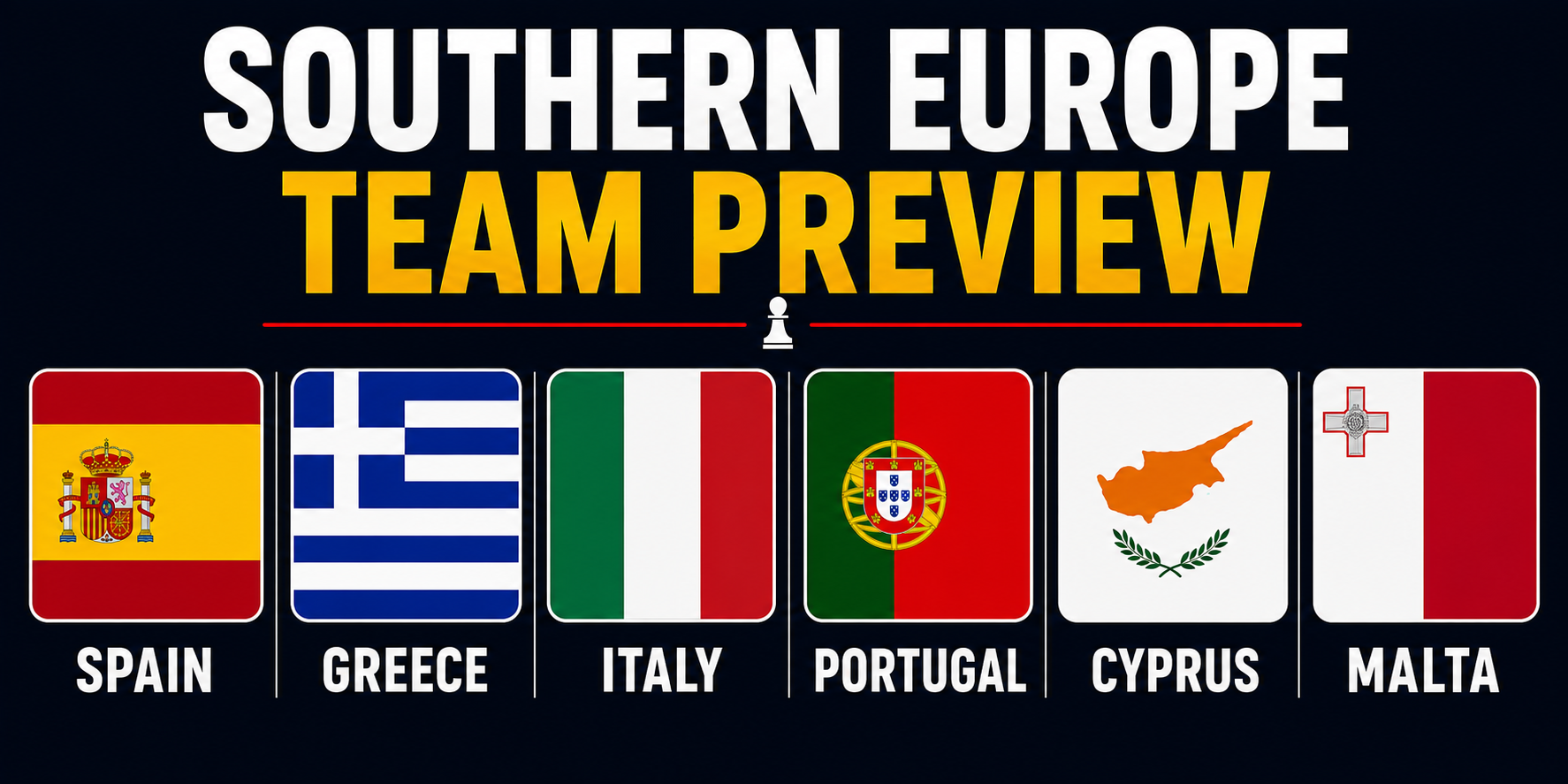
The Olympiad comes to Samarkand in 2026, and Southern Europe arrives with serious credentials. Spain slots in as the 12th seed overall in the Open section. Greece, seeded 19th, brings an all-grandmaster roster. That matters because not every region can field five or six complete GM teams anymore. Southern Europe can, and does.
Italy's story centers on the Brunello family. Sabino Brunello mans the fourth board for the Open team while his sister Marina captains the Women's squad. It's a modest setup, but it reflects a shift in how elite chess organizes itself around family units and training partnerships rather than centralized state programs. The Brunellos show what happens when a strong chess family decides to compete at the highest level together.
Cyprus mirrors this family angle. The Sokolova sisters represent the women's team, adding another sibling pairing to the regional mix. It's a pattern you see across the Olympiad now. Talent clusters around families. Training happens at home instead of in chess factories.
Malta deserves attention for the opposite reason. Their Open team features five players, all holding the Candidate Master title. That's perfect uniformity. Every player on Malta's roster sits at exactly the same rating tier. It's unusual to see such consistent rating distribution on any national team, let alone one competitive enough to qualify for Samarkand. It suggests Malta has built a remarkably stable chess ecosystem rather than relying on one or two standout talents.
Portugal completes the Southern European contingent, though the roster details remain less prominent than the others. The region overall shows what happens when smaller federations invest in their players and build multi-generational depth.
The seeding tells the story. Spain at 12th and Greece at 19th sit comfortably in the middle tier of world Olympiad competition. They won't challenge Russia, China, or India for medals. But they're far ahead of weaker federations. Southern Europe has carved out legitimate status at chess's quadrennial summit.
Samarkand will host roughly 150 teams across open and women's sections. The Southern European presence is small but credentialed. Shirov alone guarantees Spain attention. The Brunellos and Sokolovas guarantee Italy and Cyprus media coverage. Malta's uniform roster guarantees questions about their training system.
The real question is what these teams accomplished when the games begin. The seeding suggests nobody from this region will finish top ten overall. But Olympiads pivot on board-level performances and individual standout moments. Shirov could win games. The Brunellos could upset higher-rated opposition. And Cyprus or Greece could produce the Olympiad's unexpected story.