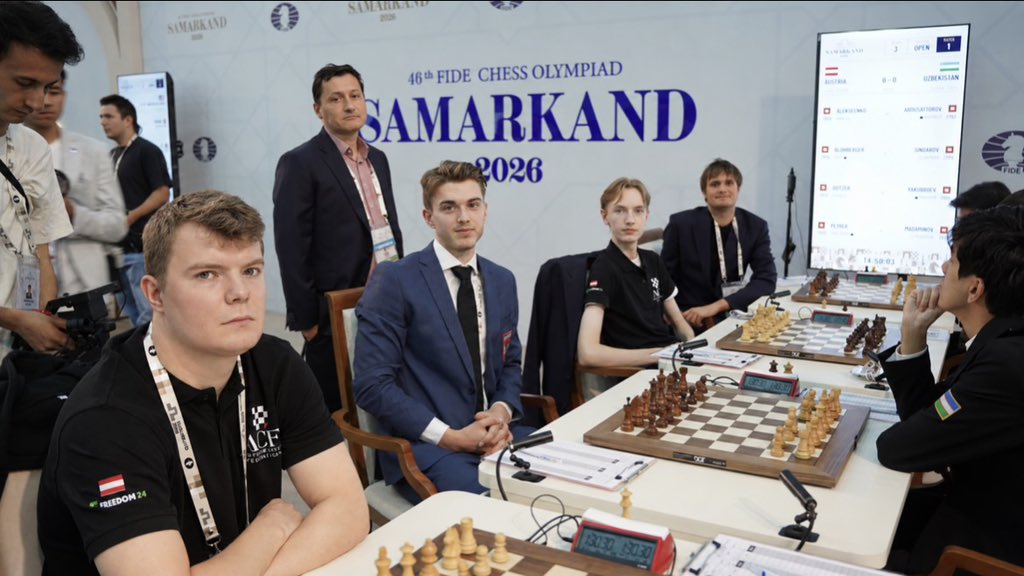
Felix Blohberger is having the kind of tournament week nobody wants. The Austrian grandmaster, rated 2550, already suffered the indignity of losing to a 2066-rated Palestinian player in round one at the Samarkand tournament. Three rounds in, his luck has not improved. Sindarov dismantled him on board three this week, forcing resignation with an aggressive combination that left Blohberger no escape route.
This is not a case of Blohberger playing bad opponents and losing to upsets. Sindarov is a serious player, and the Uzbek squad routed Austria 3-1 on the day. But the pattern matters here. Blohberger has now lost twice in three rounds to opponents of wildly different strength. That speaks to mental resilience, not just chess strength. When you're a 2550 grandmaster and you lose to someone rated 484 points below you, then lose again to quality opposition days later, the damage compounds. Confidence drains fast.
The Women's section threw up the real earthquakes in round three. Two major upsets landed in the same round, something that rarely happens at this level. The chess establishment likes to predict outcomes based on rating and pedigree. The women's event proved again that prediction is a fool's game.
Upsets at the elite women's level sting harder because the pool of players is smaller and more stable. When one of the world's best falls to an unexpected opponent, everyone notices. The margin for error at the top is already razor-thin. One bad day, one inaccurate preparation, one moment of lost focus costs you against players who are waiting to pounce.
Sindarov's win over Blohberger showed what separates boards in the open section. On board three, Uzbekistan's player had to deliver. He did. The combination he found was forcing enough that Blohberger had to resign rather than play out a hopeless endgame. That's how you win matches at this level. You make your advantage count when the moment arrives.
The Samarkand tournament is shaping up as a reminder that strength rating is not destiny. Blohberger has the title and the rating. He does not have the results. In a team event, especially one reaching round three with momentum already shifting, losing your psychological composure is catastrophic. Uzbekistan swept the day. Austria did not.
The women's section has now shown its hand. It will not defer to seeding. It will not follow the script. Next rounds will reveal whether these upsets signal a genuine shift in the competition or momentary chaos. Either way, the favorites learned something today: nobody is safe.