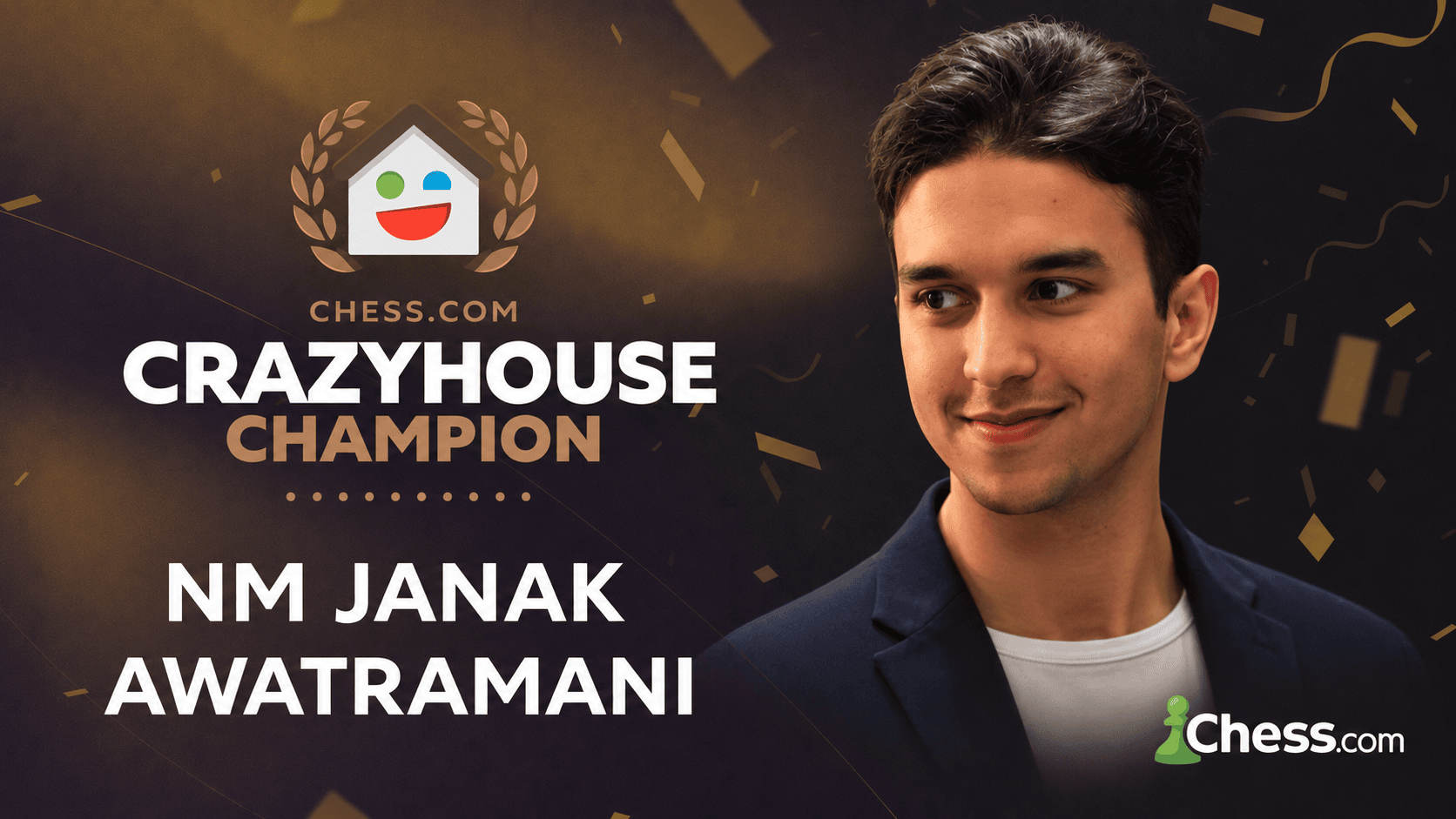
Janak Awatramani has won the Crazyhouse Championship for the second time in three years, demolishing GM Guillermo Vazquez 3-0 in the final. The National Master's dominance in this variant format now ranks him among the elite players in chess variants, a field that demands a completely different cognitive framework than classical play.
Crazyhouse remains one of the most disorienting variants for classical players. Captured pieces go into a pool that either player can drop back onto the board instead of moving a piece normally. This mechanic transforms the entire game. Material advantage means almost nothing. Piece coordination breaks down. Positional understanding evaporates. What matters instead is tactical acuity, calculation depth under extreme time pressure, and the willingness to ignore classical chess principles.
Awatramani's back-to-back championships in 2024 and 2026 tell a story about sustained mastery of chaos. He did not fluke these wins. He beat strong opposition, and he beat them convincingly. A 3-0 sweep in a championship final is not luck. That result signals that Awatramani has developed an intuition for Crazyhouse that his competitors have not yet matched.
Vazquez, a Grandmaster, brought classical strength to the board. Classical titles matter far less in variants. The move from standard chess to Crazyhouse requires abandonment of the habits that make a player a strong classical player. Vazquez, like most classical specialists, probably struggles with the psychological shift. He thinks in terms of pawn structures and piece placement. Crazyhouse punishes that thinking. A rook suddenly materializes on your back rank because your opponent dropped it there. Your carefully constructed position crumbles instantly.
The variant community has always existed in the shadow of classical chess, dismissed as entertainment or novelty rather than serious play. That attitude underestimates the skill required to play Crazyhouse at the highest level. The calculation demands are different but no less intense. You must track multiple piece positions simultaneously. You must remember what pieces sit in the pool. You must see forcing tactical sequences several moves deeper than in classical games because positions shift so radically.
Awatramani's 2024 victory established him as a rising force in variants. His 2026 win confirms he is not a one-time champion but a genuine specialist. That distinction matters for how the community perceives him. He has carved out a niche where his name belongs in the conversation with the best Crazyhouse players globally.
The broader context here involves the growth of online variants. Chess.com and other platforms have invested in promoting formats beyond classical play. This infrastructure creates pathways for players like Awatramani to build reputations and compete for titles in arenas that classical chess executives traditionally ignored. Twenty years ago, Crazyhouse championship titles barely registered in the chess world. Today, they command attention and respect among serious players who follow variants.
Guillermo Vazquez's performance raises questions about whether classical players can transition into variants competitively. The answer appears to be no, at least not at championship level. Crazyhouse specialists dominate their own championships because they have internalized the logic of the variant. Vazquez holds a classical title but could not navigate the Crazyhouse finale. That gap reveals how distinct these games really are.
Looking ahead, Awatramani will face challenges from the growing roster of dedicated variant players. The 2026 championship shows the field is taking variants seriously. More young players will specialize in Crazyhouse. More will compete for titles. Awatramani's advantage comes from his two-year head start and his demonstrated ability to execute under pressure in the variant's chaotic environment.
The rating implications for variant specialists remain murky since variant ratings operate on separate scales from classical ratings. But within the Crazyhouse ecosystem, Awatramani's name now stands at the top. Two championships in three years is the kind of record that defines eras.