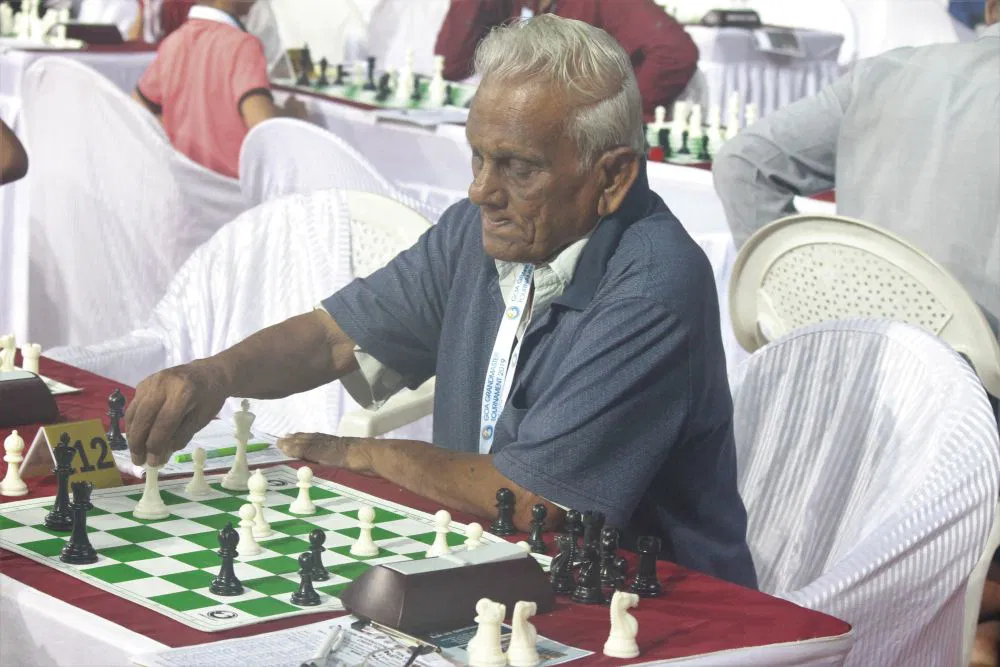
T.V. Subramanian died this weekend at 92, still showing up to tournaments. That should tell you something about the man.
The Indian master from Trichy never saw chess until he was 24 years old. That's when a coworker in Coimbatore introduced him to the game in 1958. Most players who pick up chess that late plateau quickly or quit. Subramanian did neither. He spent nearly seven decades chasing improvement, traveling to events well into his nineties when most people his age had stopped leaving the house.
His final tournament came just two weeks before his death. The Chessinfo & GKCA 1st International FIDE Rating Open in Trichy. He scored 4 out of 9 and gained 30 rating points. Thirty points. At 92 years old. That's not nostalgia or charity scoring from opponents. That's a player who still understood positions, still calculated, still competed.
David Llada, the renowned chess photographer who documented Indian chess for decades, broke the news this past weekend. He called Subramanian a "very popular personality" in Indian chess circles, someone known for his dedication to travel and tournament play regardless of his age. Llada used the term "adult improver" to describe him, a phrase you hear in chess coaching but rarely see executed with such consistency over such a timescale.
The late-blooming player has become a modern chess trope. We celebrate the teenager who breaks 2500. We analyze the prodigy's preparation. But the person who learns the game after their twenties and keeps at it for seven decades? That story challenges the sport's obsession with youth and innate talent.
Subramanian's trajectory inverts everything the chess world prizes. He didn't discover the game as a child. He didn't have a coach teaching him endgames at age six. He came to it as a working adult, almost by accident, through a friend's casual suggestion. Then he decided to keep going. Through tournaments in India's chess circuit, through the rise of the internet and online chess, through the ascent of players like Vishy Anand and the younger generation that followed.
He never became a household name. He never played in world championship matches or coached future grandmasters. But he represented something the chess world occasionally forgets in its obsession with rating points and tournament prizes. The game's value isn't reserved for those who can extract maximum rating or maximum prize money. It's also for the person who simply wants to play, to improve, to test themselves against opponents, week after week, year after year.
Subramanian kept showing up to tournaments at 92. He gained points two weeks before he died. That's how he should be remembered.