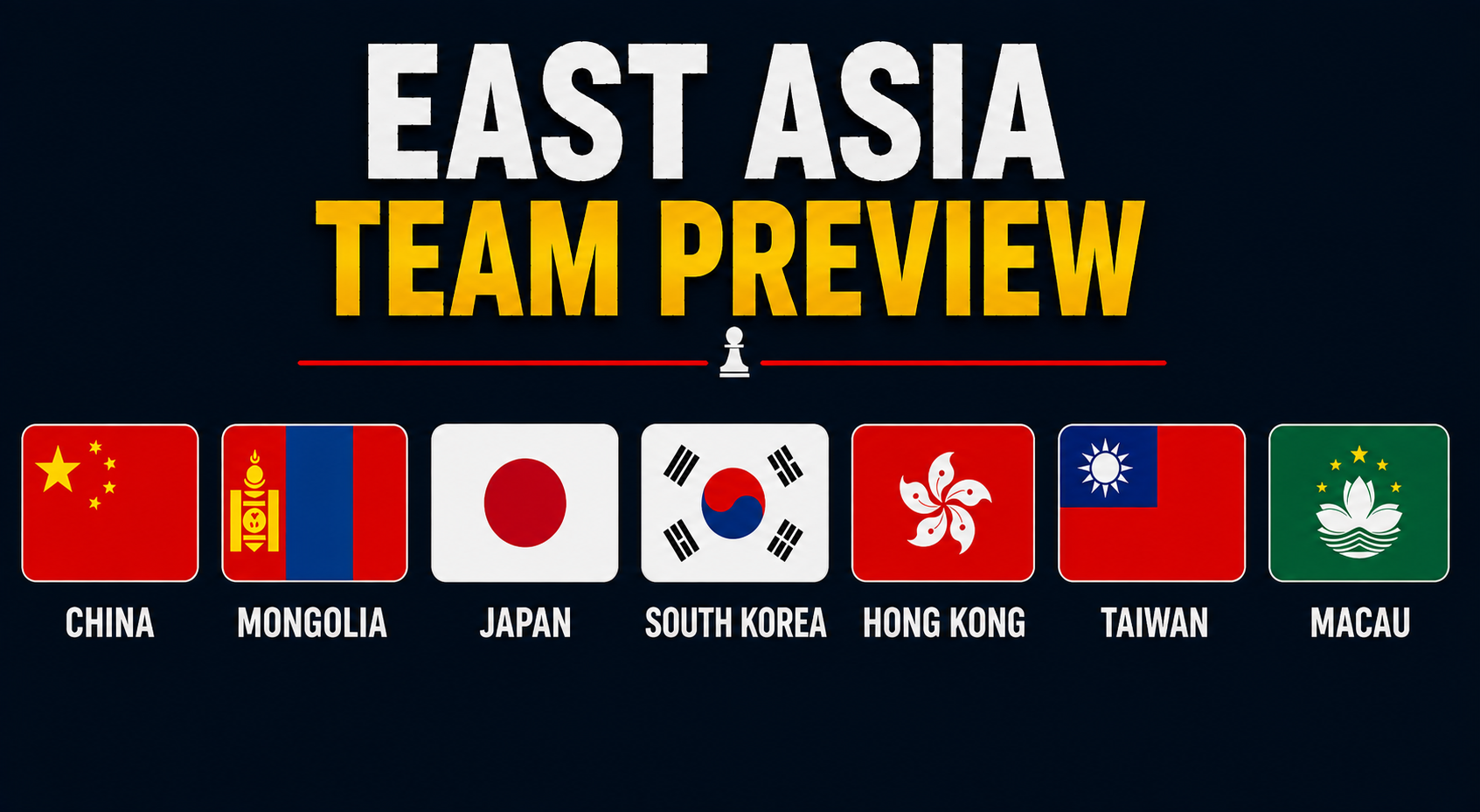
# East Asia Arrives for Olympiad 2026 as the Tournament's Deepest Regional Block
China brings a roster that rewrites expectations for what a single federation can field at the 2026 Olympiad. Ding Liren, the reigning world champion, anchors an Open team stocked with five grandmasters rated above 2500. That depth alone would dominate most continental competitions. The women's team mirrors this strength with GM Zhu Jiner leading a unit that includes two international masters, giving China genuine medal contention across both categories.
This isn't just about China's usual advantage, though. Mongolia emerges as the region's revelation. An entirely titled Open roster of GMs and IMs outperforms federations with ten times its population and resources. The federation has engineered a competitive team structure that punches far above its size. Its women's contingent nearly matches this depth, suggesting Mongolia's chess infrastructure has matured far beyond what casual observers expect from Central Asia's chess landscape.
Japan, South Korea, and Hong Kong all arrive with fully or near-fully titled lineups. This concentration of titled players across East Asia reflects decades of investment in competitive chess development. Taiwan contributes individual quality scattered through its team structure. Macau and Hong Kong round out the block, creating a regional ecosystem where nearly every federation sends credentialed competitors rather than development-stage players.
The Olympiad format rewards this kind of roster depth. A single weak board can derail medal chances in a close competition. East Asia's teams face far fewer such vulnerabilities than most regions. China's five grandmasters above 2500 means rotation decisions become strategic rather than forced. Mongolia can field multiple boards with 2400-plus strength. Japan and South Korea maintain competitive benches. This compresses the talent distribution in a way that gives East Asia multiple legitimate pathways to gold medals.
What complicates the picture: board composition matters as much as raw rating. Ding's world champion status carries psychological weight, but so does the specific mix of classical specialists, online champions, and proven match performers. South Korea's preparation culture and Japan's historical Olympiad consistency have produced surprising results before. Mongolia's rapid rise means unpredictable preparation and potentially underrated combinations of pieces.
The real test arrives when these teams actually convene in 2026. Rating lists freeze moments in time. Chemistry between boards develops or fractures during the actual tournament. Rest advantage, adaptation to opponents' styles, and the mental grind of multiple rounds separate theoretical rosters from actual results. East Asia's paper strength translates only if these federations convert individual talent into coordinated team performance. For now, the region has assembled the pieces. Execution remains ahead.