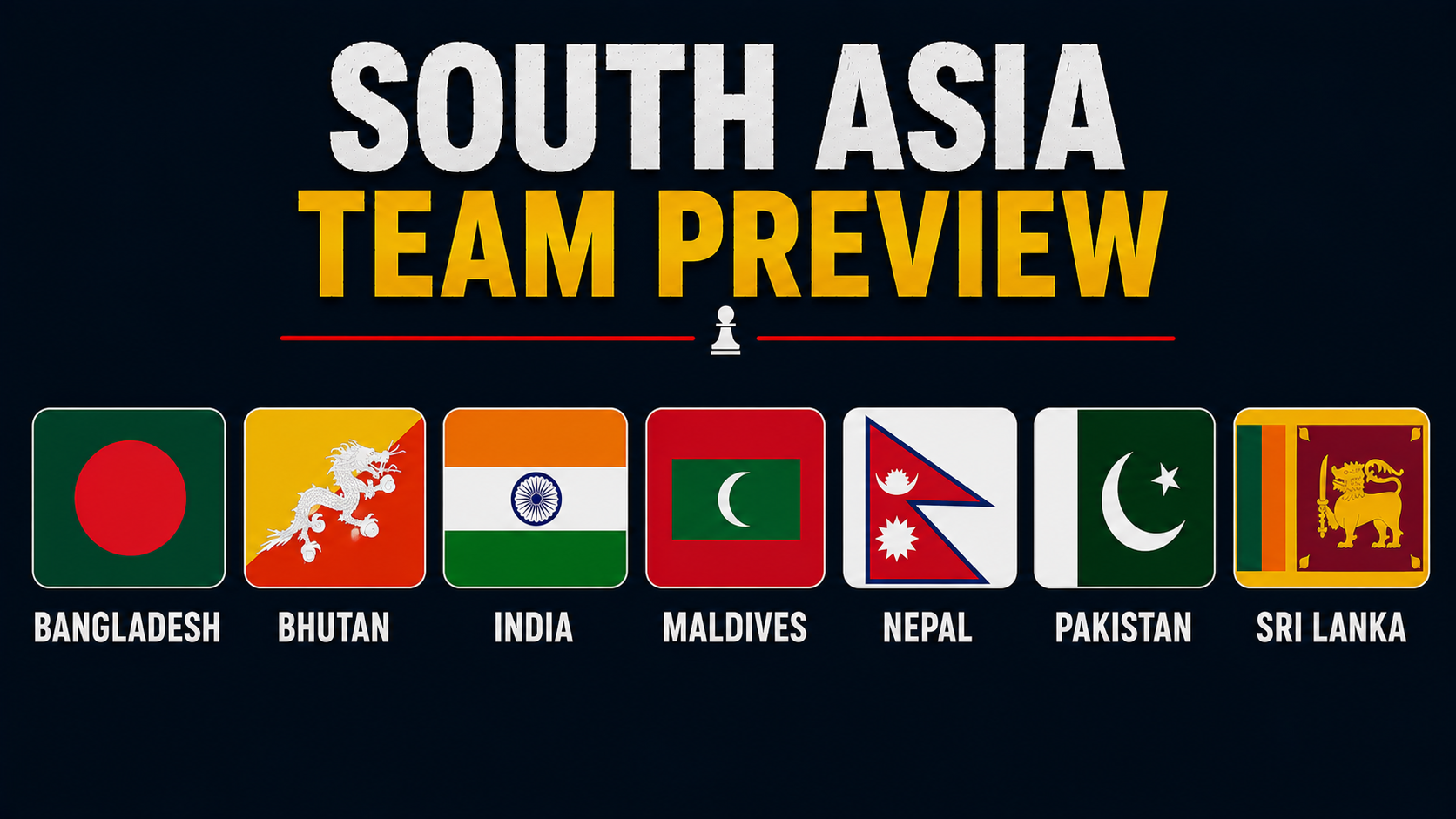
India's Olympiad team for 2026 is not just strong. It is historically stacked.
Arjun Erigaisi, Praggnanandhaa, Nihal Sarin, Gukesh, and Vidit form an Open roster averaging 2725 Elo. Put those five names on any Candidates invitation list and nobody questions it. Put them on an Olympiad team and you have something that transcends typical national squads.
This is what separates India's program from every other chess nation in South Asia, and frankly, most everywhere else.
The women's side matches that intensity. Koneru Humpy leads a three-grandmaster core with Divya Deshmukh and Vaishali Rameshbabu. Two titled IMs fill the lower boards. India doesn't field a women's team at the Olympiad. They field a women's team that competes in mixed tournaments.
Why does this matter now, before a single game in Budapest?
Team strength at the Olympiad determines medal math. Rating depth wins grinding events where board four faces 2600-plus opponents across fourteen rounds. India's fifth and sixth boards are players most federations would anchor their squad around. That depth compounds over a tournament where one loss threads into tiebreaks and overall standings.
The psychological advantage cuts both ways. India's competitors know the rating advantage exists. India's players know they're expected to win. Both shape how games unfold, especially in critical matchups where psychological momentum matters as much as calculation.
Bangladesh fields a fully titled roster and stands as the second-strongest team in the region by sheer credentials. That matters. The gap between a titled lineup and mixed titled/untitled depth still exists at the Olympiad level, and Bangladesh bridged it in recent cycles. Still, the rating spread between India's core and Bangladesh's core puts India in a different orbit.
What happens next depends entirely on one thing: execution. Erigaisi, Praggnanandhaa, and Gukesh carry rating advantages they must convert into wins and draws. Tournaments don't award medals for on-paper strength. They award medals to federations whose players navigate fourteen rounds without catastrophic collapses.
India has chased Olympiad gold for decades. The 2026 squad possesses the collective rating to claim it. Whether they do hinges on whether five 2700-plus players can play like five 2700-plus players when the stakes matter most. Talent alone never guarantees victory at the Olympiad. Talent plus consistency does.