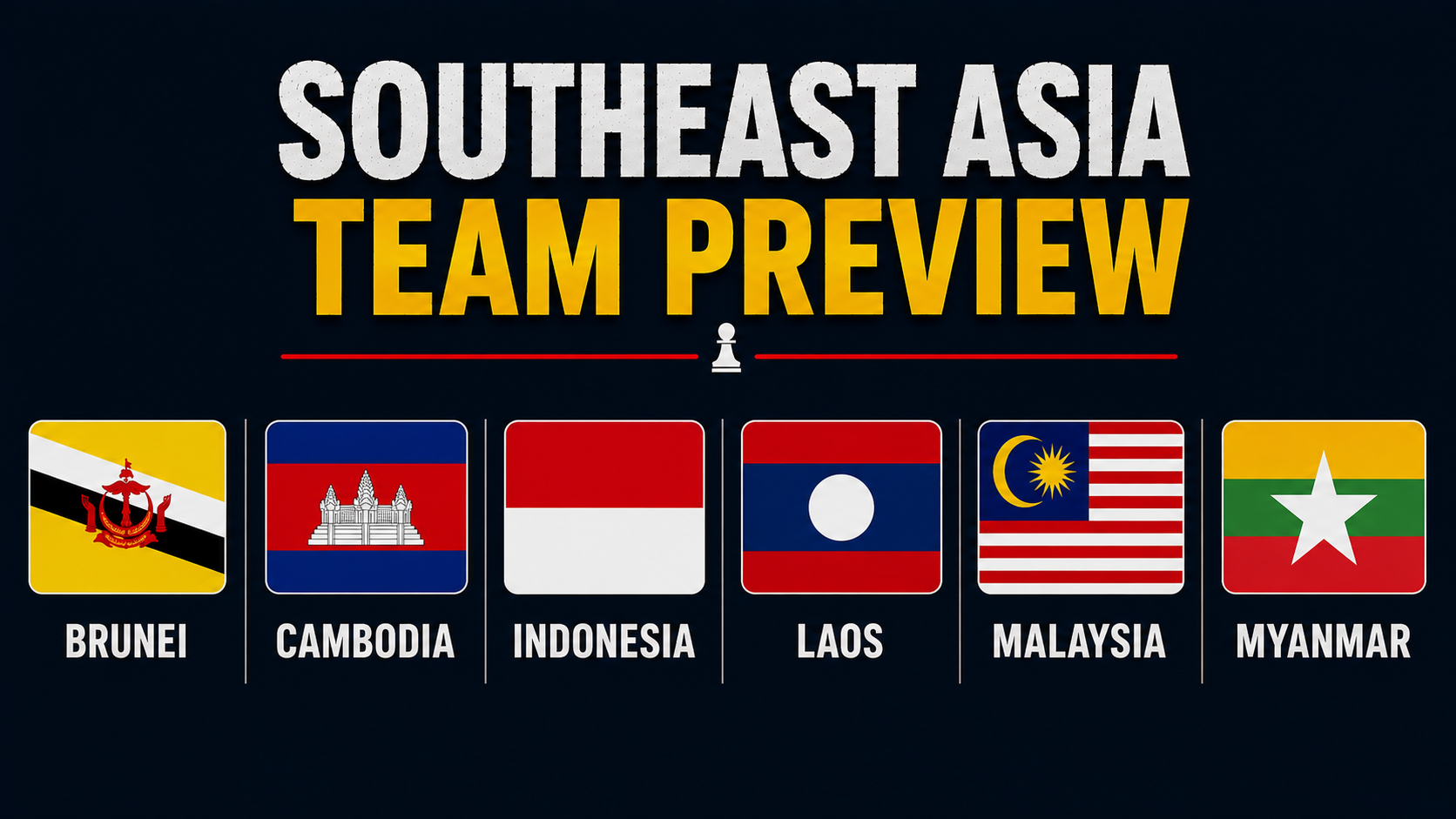
Indonesia's chess federation has built something unusual for Southeast Asia: consistency across the board. Their Olympiad 2026 roster reflects a deliberate approach to team selection that prioritizes depth over star power.
The men's side carries one grandmaster flanked by four international masters. That's a steady lineup, not flashy. But the women's team tells a different story. All five players hold the WIM (Woman International Master) title. Across every Southeast Asian federation reviewed for this cycle, Indonesia fields the most uniformly credentialed women's roster. No drop-offs. No gaps where a 1800-rated player sits next to three 2200s. Just five WIMs ready to defend their board positions.
Malaysia matches Indonesia's philosophical commitment to titles. They've qualified a fully titled squad in both Open and women's sections. For a region where rating inflation remains less pronounced than in Europe or Asia's top tier, this represents deliberate federation investment. Both countries are signaling to their players and sponsors that title attainment matters.
The contrast becomes stark with Brunei, Cambodia, Laos, and Myanmar. These federations field rosters that operate at a much more modest rating level, with several players sitting outside the titled ranks. This isn't surprising. Smaller populations, fewer professional chess cultures, and limited resources mean these nations function differently than Indonesia or Malaysia. They're not developing grandmasters at the rate of Thailand or the Philippines. Their Olympiad participation is genuine representation, not genuine competition for medals.
What matters here is trajectory. Indonesia's WIM-heavy women's squad suggests the federation identified a pipeline and promoted it. This is how nations build. Russia didn't always have forty female grandmasters. They decided woman's chess mattered, invested in training, and the titles followed. Indonesia appears to be following a scaled version of that playbook.
The 2026 Olympiad will test whether consistent titling translates to consistent results. Indonesia's men will face serious competition from Vietnam, Thailand, and the Philippines. The women could surprise in their section, especially if any WIM among the five breaks through to 2300+ strength during the next two years.
Malaysia's titled approach carries similar upside. These aren't the strongest rosters in the world. They're the most deliberately constructed rosters Southeast Asia has sent to an Olympiad in recent memory. That counts for something.