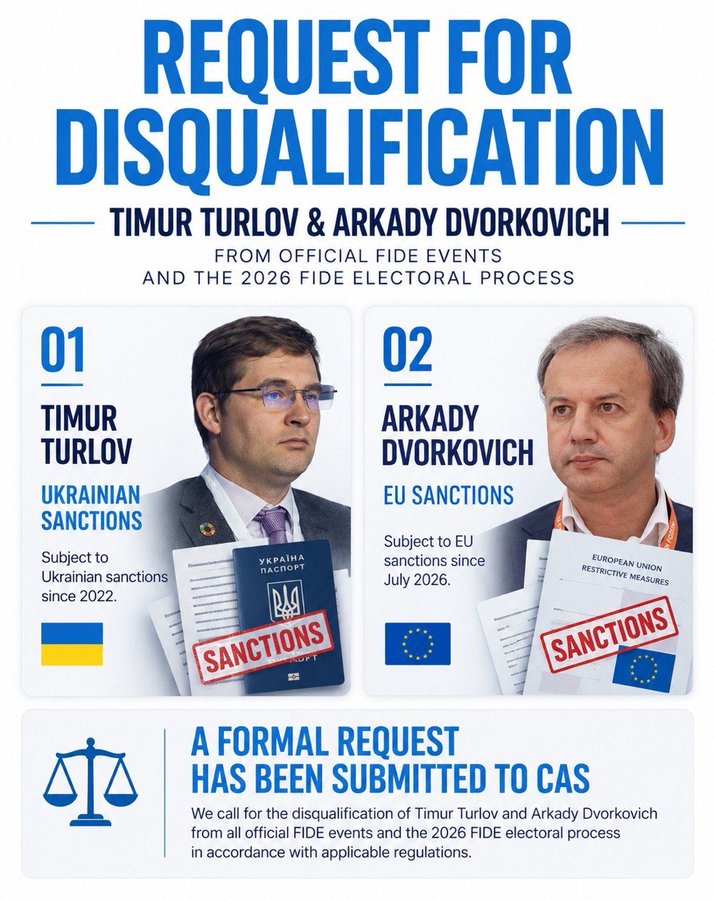
Wadim Rosenstein is taking FIDE to arbitration over what he argues is selective enforcement of its own rules.
The Russian businessman filed an appeal with the Court of Arbitration for Sport in Lausanne, demanding an independent review of how FIDE applies its sanctions policy ahead of the September 26 presidential election. The case centers on a FIDE Council decision from March 2022 that explicitly prohibits sanctioned individuals from holding official positions within the federation or attending FIDE events.
Rosenstein's complaint is simple but potentially damaging to FIDE's leadership: the federation is not enforcing this rule consistently. If he can prove selective application, it weakens FIDE's credibility on governance at precisely the moment when its presidential succession is being decided.
This matters because FIDE elections happen in a fishbowl. Any hint that the rules are applied to some candidates but not others generates suspicion that the process favors incumbents or certain factions. Chess politics already runs hot. A CAS ruling that finds FIDE broke its own standards would embarrass the federation and cast doubt on whoever wins the election.
Rosenstein's move is tactically smart. CAS operates independently from FIDE. It has authority that FIDE's own appeals bodies lack. By going to Lausanne instead of fighting within FIDE's structures, Rosenstein bypasses the federation's internal politics entirely. CAS doesn't care about FIDE power dynamics. It cares about whether published rules were followed.
The timing is aggressive. The election is less than three months away. If CAS takes the case and rules in Rosenstein's favor, it forces FIDE to revisit its enforcement decisions during an active campaign. That's chaos for any sitting leadership trying to manage a transition.
What makes this interesting is that FIDE rarely faces public legal challenges from within the sport. Most disputes get buried in closed committee meetings. Rosenstein is dragging FIDE's governance into sunlight. Win or lose, he's established a precedent that FIDE cannot simply invoke rules and ignore them without external scrutiny.
The federation will have to mount a serious legal defense, not just a bureaucratic one. That costs resources and attention during an election cycle when FIDE should be focused on candidate vetting and federation business.
Whether CAS accepts the case and how quickly they move remains unclear. But Rosenstein has already accomplished something: he's forced FIDE to answer for consistency. That's rare leverage in chess politics.