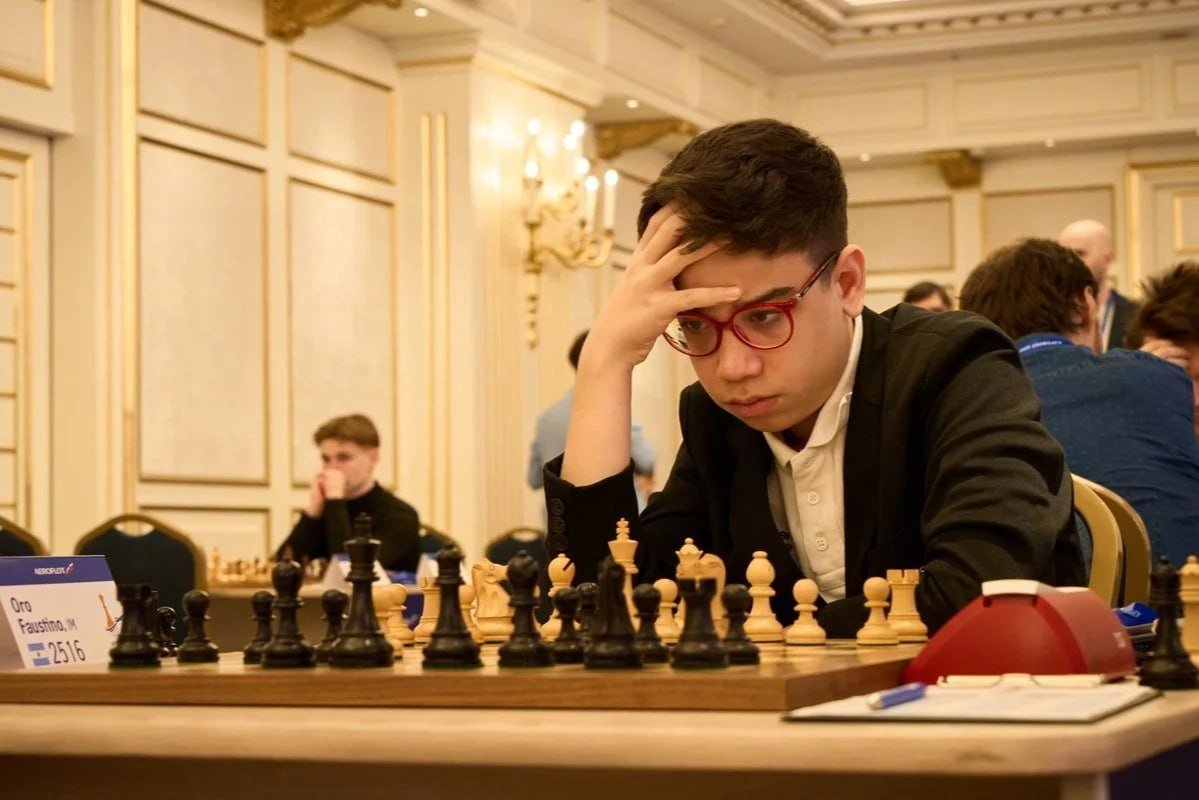
Faustino Oro has found the perfect way to dismiss an entire tradition of chess study in a single sentence. The 12-year-old Argentine grandmaster, already operating at a level that took Kasparov and Carlsen years of grinding to reach, doesn't read chess books. Not because he can't. Because he doesn't need to.
The shift Oro describes is real and growing sharper by the month. The gap between his generation and Carlsen's is not just a few years. It's a chasm of technological difference. When Magnus was learning, he studied Kasparov's 200 Ply games, annotated lines, endgame compendia. He sat with books for hours. That was the path. There was no other efficient path.
Oro has engines. He has training databases containing millions of games, searchable by position, by opening, by player. He has Monte Carlo tree search analysis that finds moves no human annotator would have noticed. He has video coaches breaking down positions at machine-readable depth. The learning curve that took Carlsen into his teens to master, Oro compressed into childhood.
This isn't him being cocky, though the quote certainly reads that way. He's stating an observable fact about how chess education has transformed. The bottleneck was always information. Books were expensive, scarce, and required interpretation. Now a tablet and an internet connection deliver more chess knowledge than existed in all the libraries of the 1980s.
The practical implications cut both directions. Oro's rapid ascent to grandmaster status at 12 proves that computer-assisted learning works at scale. You don't need Kasparov's training regimen anymore. You need pattern recognition, competitive drive, and access to silicon.
But there's a risk embedded in his confidence. Chess books force you to think about why moves work, not just what works. Kasparov's annotations taught strategic philosophy. A database returns positions without philosophy. Oro's generation learns tactics and calculation at superhuman speed. Whether they develop the same strategic depth remains an open question.
The real story here is generational permission. Oro doesn't feel obligated to walk the path Carlsen walked. That path is now obsolete. He's building a new one using tools that didn't exist when Magnus was 12. The old guard learned from books because they had no alternative. The new guard doesn't read them because they've already moved past that limitation entirely.
Chess education just became unrecognizable between two generations born 20 years apart.