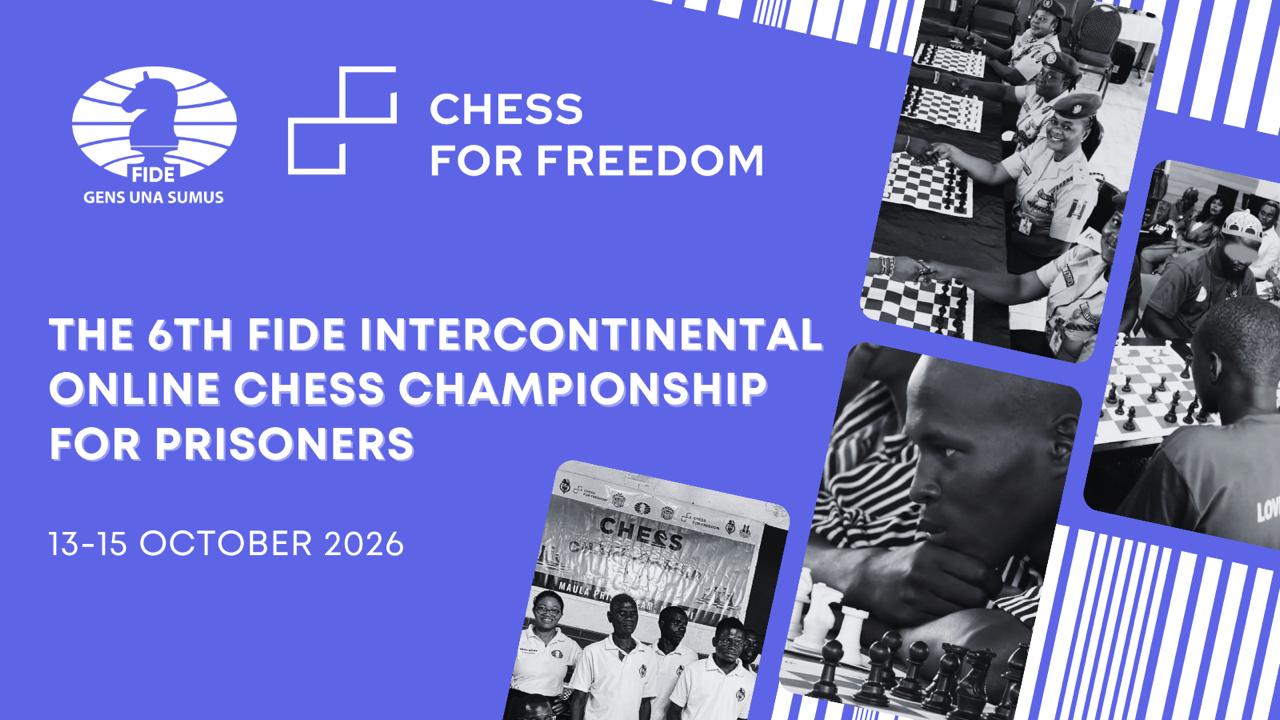
Prison chess has become a genuine international movement, and the numbers prove it. The 6th Intercontinental Online Chess Championship for Prisoners drew 140 teams spanning 56 countries this October, shattering the previous participation record. This is no longer a niche event. It is mainstream.
The tournament itself ran October 13-15 with sections for men, women, and youth players. FIDE and the Cook County Sheriff's Office organized the championship using a 10-minute time control with five-second increment, a format that works across time zones without creating the slow-play problems that plague longer classical events. Teams were stratified by geography to manage scheduling, with advancement structures that rewarded top finishers.
What matters here goes beyond the headline numbers. Prison chess programs have shifted from being rehabilitative novelties to becoming organized competitive ecosystems. When Mongolia fields a team, when 56 nations coordinate participation in a single tournament, the activity has crossed from grassroots into institutional support. Prison administrations now see chess as worth the infrastructure investment. They allocate resources for equipment, internet access, and scheduling. That does not happen by accident.
The inclusivity piece matters too. A dedicated women's section and youth bracket acknowledge that prison populations are diverse. The tournament treats female and younger players as full participants, not afterthoughts. That structural choice signals how seriously organizers take equity within the prisoner chess community.
Mongolia's strong showing in the men's section reflects a regional chess culture bleeding into incarcerated populations. Mongolian chess expertise does not disappear behind prison walls. If anything, it intensifies under the structured conditions that correctional facilities provide. Time to study, fewer external distractions, competitive peers. These are the conditions that produce strong players.
The real breakthrough here is sustainability. One-off tournaments generate buzz. Repeating a tournament six times, each edition larger than the last, demonstrates that this has staying power. Participants know the event will happen next year. They train for it. Prison administrators budget for it. FIDE sanctions it. That institutional predictability transforms chess from entertainment into genuine prison culture.
The next question is whether organizers expand the format further. Could this become a qualifier system feeding into larger continental championships? Could online play eventually evolve into in-person world championship events for incarcerated players? The infrastructure is there. The demand clearly exists. The only barrier is whether the chess world continues to view this as peripheral or central to what competitive chess actually means.